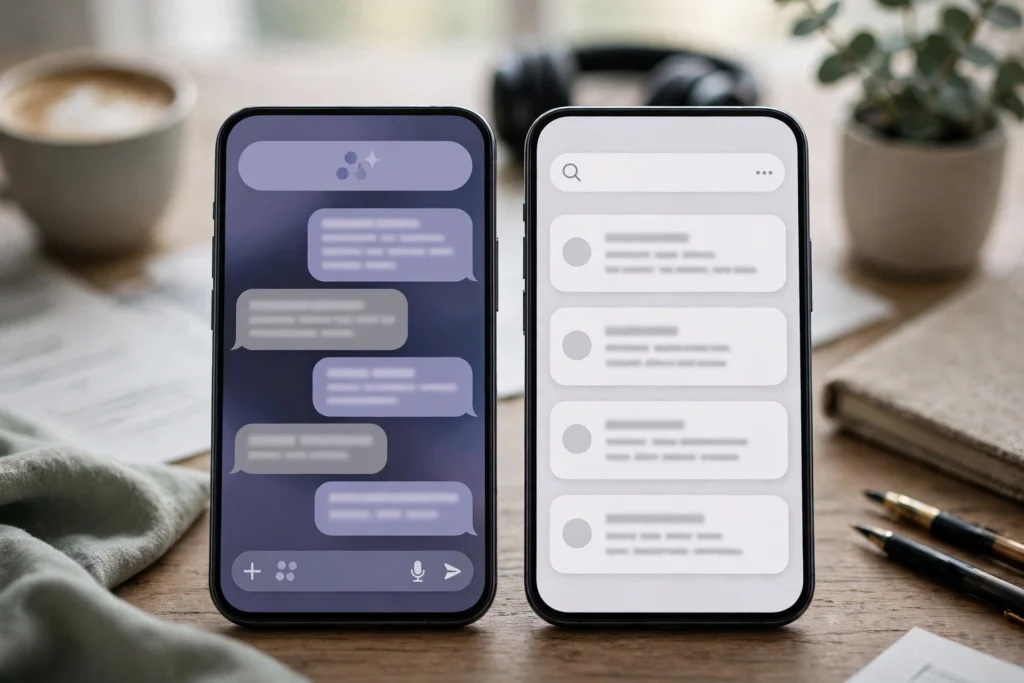
AI Mode vs AI Overviews is the distinction that decides where your brand actually appears in Google’s AI search: AI Overviews are the AI-generated summaries shown at the top of a traditional search results page, while AI Mode is Google’s separate, conversational search experience where users ask follow-up questions in a chat-like thread. They cite different pages at different rates, they disappear and return at different speeds, and a brand that tracks only one of them is measuring half its AI visibility.
This article explains the difference in plain terms, what recent citation research found about each surface, and how link builders should adapt their tracking and their tactics for each one.
What is the difference between AI Mode and AI Overviews?
AI Overviews appear inside normal Google search: you type a query, and above the familiar blue links you get a generated summary with cited sources. AI Mode is a different destination — a conversational interface where the user refines the question over several turns and the assistant answers with links woven through a longer response.
The practical differences for brands:
- Query style: AI Overviews answer a single query; AI Mode handles multi-turn, exploratory research (“compare these three tools, now filter for under $50”).
- Answer length: AI Mode answers are typically longer and cite more sources per answer.
- User intent: AI Overview users are often looking for a quick answer; AI Mode users are often mid-research, closer to a shortlist.
- Measurement: the two surfaces do not share one citation pool, so a mention in one does not imply a mention in the other.

How stable are citations on each surface?
Ahrefs’ citation-stability research, tracking tens of thousands of citations over 20 days across five AI tools including both Google surfaces, found that citations are volatile everywhere — roughly half of AI Overview citations had disappeared by day two, and a higher share of AI Mode citations did the same — but most lost citations returned within about 20 days. Citations that survived eight days or more returned 96–99% of the time. The study’s sample included 1,996 AI Mode questions with 18,009 cited sites and 563 AI Overview questions with 4,830 cited sites. Read the research via the Ahrefs blog.
The lesson is not that citations are random. It is that a single-day check is meaningless: a brand can be cited on Monday, absent on Tuesday and cited again the following week, without anything about its content changing. Track mentions over weeks, not days.
Why are brand mentions a better KPI than citations?
The same research found that brand mentions — the brand being named in the answer text, with or without a link — are more stable than citations. That matches what our earlier article on brand mentions in AI search found: mentions correlate more strongly with AI visibility than raw backlink counts, though the relationship is correlational, not proof of causation.
For link builders, this reframes the job. A guest post or listicle entry that names your brand clearly, in context, and on a page AI systems trust may matter as much as whether that page’s link is followed. It also means unlinked mentions deserve attention: our guide to converting unlinked brand mentions shows how to turn a mention into a link without losing the mention itself.
How should you track AI Mode vs AI Overviews separately?
Track the two surfaces as separate channels:
- Build two prompt sets: short factual queries for AI Overviews, and longer comparison and “best for” prompts for AI Mode, matching how each surface is actually used.
- Record mentions and citations separately: note whether your brand is named, linked, both, or neither — on each surface, on each date.
- Look at trends over 3–4 weeks: ignore single-day drops; act only on sustained absence from a surface where competitors consistently appear.
- Compare against competitors, not against zero: if no brand in your niche is cited for a query, the query may simply be unanswerable from current sources — an opportunity to create the source.

What content wins on each surface?
AI Overviews favour concise, directly answerable pages: clear definitions, short answers up front, and structured facts an answer can quote. AI Mode favours depth: comparison pages, listicles and guides that survive several rounds of follow-up questions. That split maps neatly onto two of our recent pieces: the guest posts and AI citations guide for answer-first structure, and our link building for 2027 framework for the tactics worth keeping as AI surfaces evolve.
One tactic serves both: getting your brand into the trusted third-party pages each surface cites — reviews, comparisons and expert guides — rather than relying only on your own site to be chosen.
What should link builders do differently for AI Mode?
For AI Mode, depth and breadth matter more than a single perfect page. Build and earn:
- Comparison and listicle coverage that names your brand alongside competitors.
- Guides that answer follow-up questions, not just the first query.
- Third-party mentions on pages AI Mode already trusts for your topic.
For AI Overviews, the priorities are narrower: a clear, quotable answer on your own page, structured facts, and a cited source that an overview can lift verbatim.
What should you stop doing?
Stop reporting a single citation count as “AI visibility”. Stop optimising only for the surface you personally use. And stop treating a one-day absence as a crisis — the research shows that is normal volatility, not a penalty.
Instead, report mentions and citations separately, per surface, over rolling four-week windows. That is the reporting that lets a client see whether AI Mode vs AI Overviews performance is genuinely improving — and where the next link or mention should come from.
Do AI Overviews and AI Mode cite the same pages? Not reliably. They have different query styles, answer lengths and citation pools, so a page cited in one may not appear in the other. Track them separately.
How often should you check AI citations? Weekly checks, reported as four-week trends, are more useful than daily checks. Daily volatility is high; eight-day survival is a better signal of a durable citation.
Are brand mentions enough without links? Mentions are a useful visibility signal and are more stable than citations, but links still matter for traffic and rankings. The strongest position is a mention and a link on a trusted third-party page.
AI Mode vs AI Overviews is not a choice between two tools. It is two different surfaces, with different users, different citation behaviour and different content that wins. Track them separately, build for both, and your brand mentions will show up where buyers actually look.