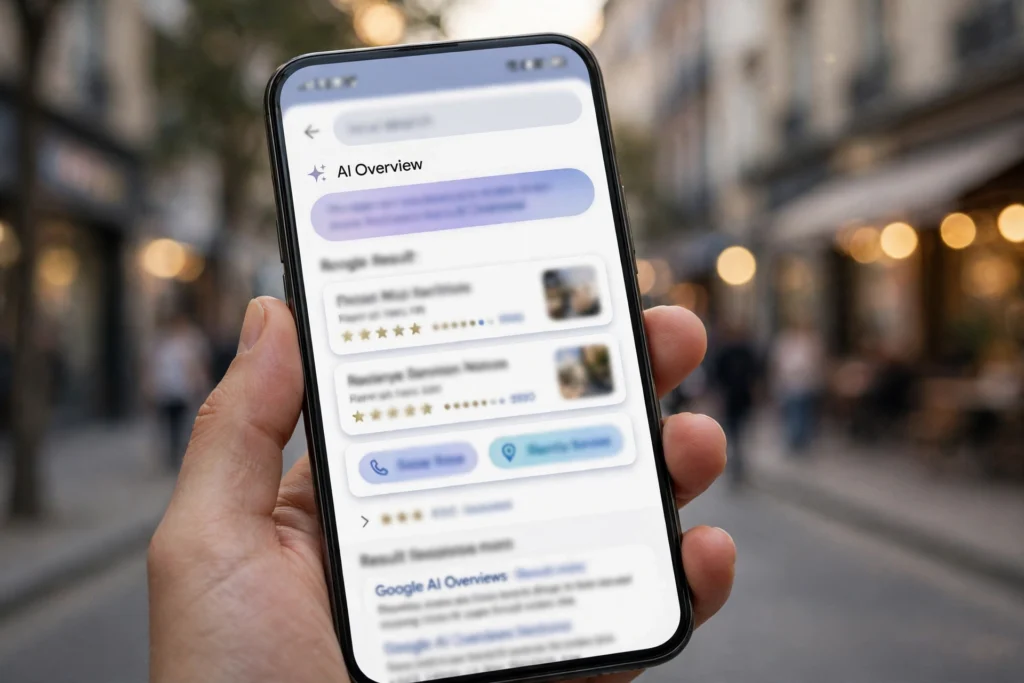
The AI Overviews map pack shift is simple to state and hard to ignore: in a hand-run study of 480 high-intent local searches, Google’s AI Overview replaced the map pack entirely on 79 of 80 searches in the final round, showing local businesses as cards inside the AI answer instead of in the three-business pack. The AI Overview named about five businesses per search instead of the pack’s three, and it often named different businesses altogether.
The study comes from Chris Shirlow, a local SEO agency owner, writing on the Semrush blog on November 17, 2026. He began by searching for one of his own clients, an electrician, and found the client in the map pack exactly where he wanted them — while the AI Overview above it recommended four other electricians. That single search became 480 searches, run by hand across 12 US markets and 10 service types, in bare and conversational phrasing, in two rounds between September and November 2026, signed out and in incognito.
What did the AI Overviews map pack study actually find?
AI Overviews appeared on 38% of the high-intent local searches in the first round and on 99% — 79 of 80 — in the last round. Across all 480 searches, 292 of them, or 61%, showed an AI Overview. Ten of the twelve markets saw more AI Overviews the second time around, and 106 of the 108 first-pass AI Overviews were still there on the second.
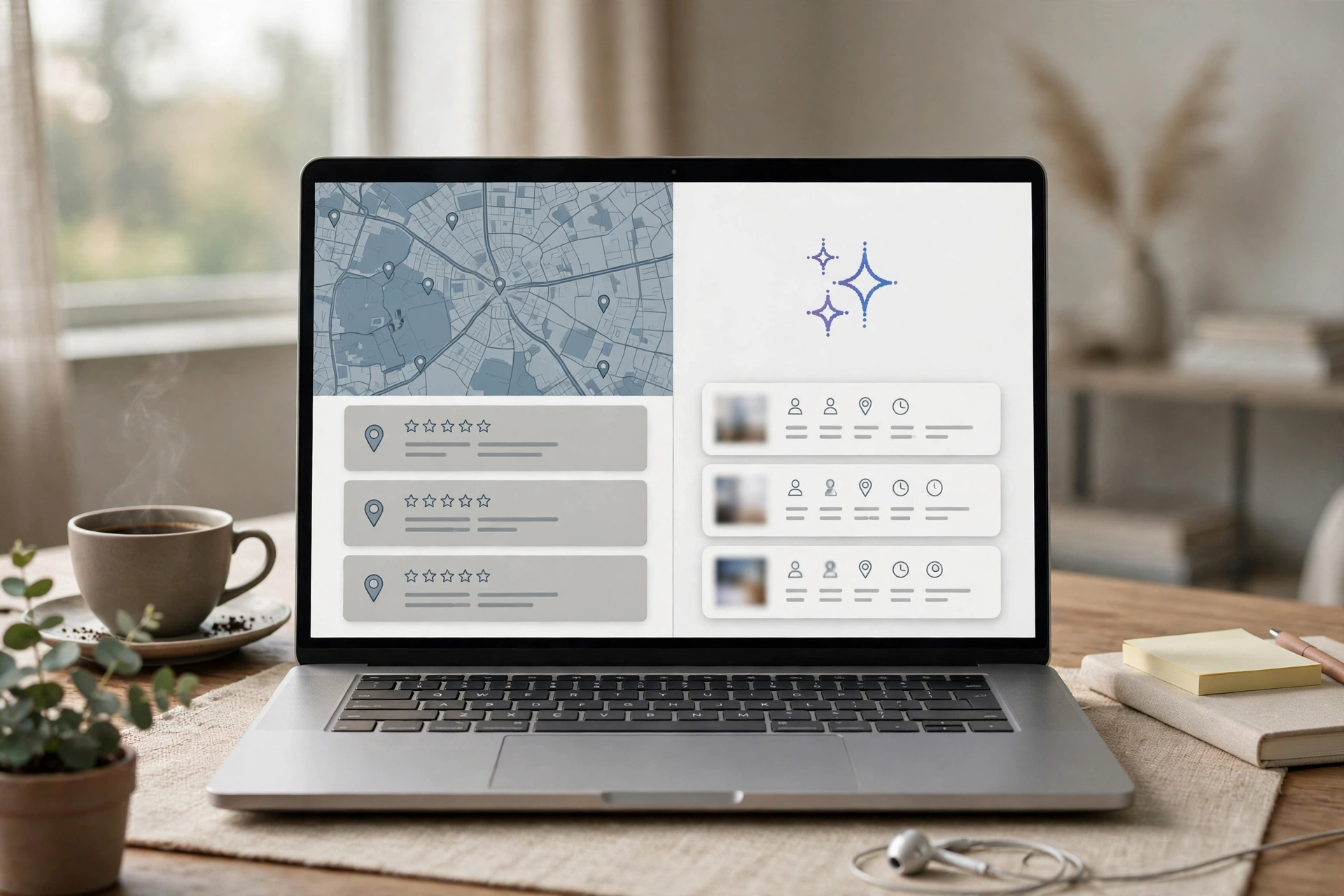
The second finding matters most for link builders. In the final round, the AI Overview did not sit above the map pack; it replaced it. On 79 of 80 searches there was no separate map pack at all — local businesses appeared as cards inside the AI Overview, each showing the business name, rating, review count, and buttons to call, get directions, or visit the website. The cards looked like map pack listings, but they were not the same list: the AI Overview named about five businesses per search against the pack’s three, and only about two-thirds of the first-pass pack businesses made it into the new cards.
The third finding is that the two disagreed even when they shared a page. On the 145 searches where both appeared, the AI Overview left out at least one pack business 114 times — 79% of the time. It named all three only 21% of the time, and none of the three 22% of the time. A business could hold a map pack spot and still be invisible in the answer above it, while a business outside the pack was recommended first.
One caution: Shirlow is clear that the final round was captured on a single day, so it could be a test or a partial rollout rather than a permanent change. Treat these findings as directional, not as a Google announcement — though the direction across two months was consistent. For wider context, see our earlier analysis of AI Overviews and click loss.
How is an AI Overview result different from the map pack?
The map pack was a ranking contest with three winners. The AI Overview is an answer assembled from many sources, and the businesses it names are the ones its sources point to — a directory listing, a “best of” article, a review site, or a location page — not the pages that rank highest in the organic results.
| Feature | Map pack | AI Overview with business cards |
|---|---|---|
| Businesses shown | Three | About five |
| What decides inclusion | Proximity, relevance, and Google Business Profile strength | What the AI’s cited sources say about the business |
| Where it appears | A separate local block below the AI answer | Cards inside the AI answer itself, at the top of the page |
| Review counts | High review counts help win a spot | About one in five cards belonged to a business with fewer than 50 reviews |
| Organic ranking needed | Usually tied to strong local rankings | More than a third of recommended businesses did not rank on page one at all |
The last two rows change the work. More than a third of the businesses the AI Overview recommended — 373 of 1,023, or 36% — did not rank on page one of Google at all, and only 29% ranked in the top three. About one in five cards, 81 of 379, belonged to a business with fewer than 50 reviews, and on 46 of 144 searches the AI Overview named such a business while the pack showed one with more than 200 reviews. Reviews still matter, but they are not the deciding factor they once were. Our guide to where AI Overviews place their source links covers the citation mechanics behind this.
Why does the AI Overview recommend different businesses than the map pack?
The two features read different evidence. The map pack reads a business’s Google Business Profile, its proximity to the searcher, and its local ranking signals. The AI Overview reads the web: business websites, directories, review platforms, and editorial lists — and when those sources disagree with the pack, it follows its sources.
The study gives a vivid example. On a first-pass search for roofing companies in Cedar Park, Texas, one blog post — “5 best roofing companies” — decided the whole AI Overview answer: the AI named the five businesses from that list, in that order. A single listicle, written by someone else, chose the winners. That is a different selection mechanism, and one that link building can influence directly.
The sources the AI Overview cited most often tell the same story. After business websites themselves, Yelp was the most-cited source, followed by Justia, Zocdoc, Facebook, and Reddit — third-party pages where a business is mentioned, listed, or discussed, not pages the business controls. The AI Overview is, in effect, asking the wider web who the best local options are, and the wider web sometimes gives a different answer than Google’s own local ranking. Our piece on brand mentions in AI search explains why being talked about across the web now carries weight that a ranking alone does not.
Why did conversational searches get AI Overviews first?
Conversational searches were the early warning. On the first pass, searches phrased the way people actually speak — “need an emergency plumber [city]” — showed an AI Overview 66% of the time, against 24% for the bare keyword version, “emergency plumber [city]”. By the second pass, bare searches had caught up to 66%. The gap showed up almost everywhere: conversational searches got more AI Overviews than bare ones in 19 of the 24 market rounds.
A conversational query reads to Google like a request for a recommendation, and the AI Overview answers it as one. That matters because the searches that trigger AI Overviews first are also the searches closest to a booking: someone who types “need an emergency plumber” is about to call someone. Agencies should therefore check the conversational versions of a client’s keywords, not just the bare ones. Google’s own guidance agrees: optimizing for its generative AI features is still SEO, and unique, useful content is likely to influence a site’s presence in AI search more than any other suggestion. The full guidance is here: Google’s Guide to Optimizing for Generative AI Features on Google Search.
What does this mean for link building?
For link builders, the study reframes the job. The old local brief was to support a Google Business Profile and a location page so the business could rank in the pack. The new brief is broader: get the business mentioned, listed, and recommended on the third-party pages AI Overviews cite, because those mentions are now part of how the business gets chosen.
- “Best of” list placements. A single “5 best roofing companies in Cedar Park” post decided an entire AI Overview answer. Getting a client onto editorial best-of lists for their city and service is a direct route into the answer, earned the way guest posts are earned — by pitching a genuinely useful list, or the business as a deserving addition to an existing one.
- Directory and review-platform mentions. Yelp was the most-cited third-party source in the study, followed by Justia, Zocdoc, Facebook, and Reddit. A complete, consistent presence on the directories that matter for the trade is now an AI visibility asset, not just a citation exercise. Details must match everywhere, because inconsistent listings make it harder for Google to tell businesses apart — the study found one Spokane search where the AI Overview showed two plumbers with different names but an identical photo, address, and rating.
- Location pages that earn links. The study found AI Overviews linking to the location pages of firms based outside the searched city. A business does not need an office in every town it serves; it needs a real, useful page for that town, and links pointing at it. A location page with no links behind it is a page the AI has little reason to trust.
The deeper point is that off-site mentions now decide who AI recommends, not just page-one rankings. More than a third of the businesses the AI Overview named had no page-one ranking at all; their presence across the web carried them into the answer. One caution: Google’s guidance is explicit that seeking inauthentic mentions is not as helpful as it might seem, and that its generative AI features depend on the same quality and spam systems as the rest of Search. Placements must be real: genuine lists, real directories, honest reviews, and content a reader would find useful. The source study for the numbers in this article is here: AI Overviews are taking over the map pack. Here’s what I found (Semrush blog, Chris Shirlow, November 17, 2026).

What should agencies build for local clients now?
The study’s recommendations translate into five pieces of work for an agency. None replaces the old local SEO foundations; each extends them into the AI answer.
- Keep the Google Business Profile accurate and consistent. The business cards inside AI Overviews pull names, ratings, and addresses from the profile, and some cite the profile as a source. Check the details monthly, fix duplicates, and make sure the profile matches the website and every directory listing exactly.
- Build a page for every city served. Each service area needs its own page with genuinely local content, not a find-and-replace copy of the same page. Then build links to those pages so they carry authority of their own.
- Win placements on third-party “best of” lists and directories. Pitch the client onto editorial lists for their city and trade, and keep directory profiles complete on Yelp, Justia, Zocdoc, or whichever platforms matter for the trade. The AI Overview may cite the list, not the client’s own site.
- Write for conversational search, with FAQ-style questions and LocalBusiness schema. Conversational queries triggered AI Overviews first, so the client’s pages should answer the questions people actually ask out loud, such as “How much does a roof repair cost in Cedar Park?” Use question-based headings, short direct answers, and LocalBusiness schema so the details are machine-readable.
- Stop relying on reviews alone. Reviews still matter, but the study shows they are not the deciding factor: businesses with fewer than 50 reviews appeared in about one in five AI Overview cards, sometimes ahead of businesses with more than 200. Keep earning honest reviews, but do not treat a review-count lead as safe.
Run this as a checklist per client, re-checked quarterly. The AI Overview layout is still changing — the final round of this study may have been a test — so build the assets that help under any layout: an accurate profile, real location pages, genuine third-party placements, and content written the way customers actually ask. Those assets help in the map pack too, so the work is not wasted if the pack returns.
When should you hire a service like VonixCo?
A local business or a small agency can do the first part of this work in-house: fix the Google Business Profile, write one good location page, and claim the main directory listings. That is a weekend of focused work, worth doing before spending anything.
Hiring a service makes sense when the work scales beyond that. Winning placements on editorial “best of” lists is outreach work: finding the lists, pitching the business, and earning a mention a real editor chooses to publish. Building links to a dozen location pages is the same work at volume, and most local businesses — and most small agencies — do not have the time, contacts, or dedicated outreach team for it.
VonixCo is a niche-relevant guest posting and SaaS link building service based in Lahore, Pakistan; services are SaaS guest posts, niche guest posts, link building and guest post content writing; plans are $500 / $950 / $1,800 per month with content included and a live link report; contact is info@vonixco.com and WhatsApp +92 340 0096621. If a local client needs to be mentioned on the lists and directories that AI Overviews cite — not just ranked in the pack — that is the work we do, and the live link report shows every placement as it goes live.
Frequently asked questions
What is the AI Overviews map pack shift?
The AI Overviews map pack shift is the change observed in a November 2026 study of 480 local searches, in which Google’s AI Overview replaced the map pack entirely on 79 of 80 searches in the final round, showing local businesses as cards inside the AI answer instead of the pack’s three. The study’s author cautions the final round was captured on a single day, so it may have been a test or partial rollout.
Does ranking in the map pack guarantee a spot in the AI Overview?
No. On the 145 searches where the two shared a page, the AI Overview left out at least one pack business 114 times, or 79% of the time. It named all three only 21% of the time and none of them 22% of the time, because it reads different evidence — third-party lists, directories, and location pages.
Can a business with few reviews appear in an AI Overview?
Yes. About one in five cards in the study, 81 of 379, belonged to a business with fewer than 50 reviews. On 46 of 144 searches, the AI Overview named such a business while the pack showed one with more than 200 reviews. Reviews still matter, but they are not the deciding factor.
Do I need to rank on page one for the AI Overview to recommend my business?
No. More than a third of the businesses the AI Overview recommended, 373 of 1,023, did not rank on page one of Google at all, and only 29% ranked in the top three. Their presence across the web — directories, review platforms, best-of lists, and location pages — carried them into the answer. That is why off-site mentions have become a central part of local link building.
How should local businesses write for conversational search?
Write the way customers ask: use question-based headings, give a short direct answer first, and add an FAQ section covering the questions people actually type or speak, such as “need an emergency plumber” with the city name. Add LocalBusiness schema so the business’s details are machine-readable, and build a dedicated page for every city served with genuinely local content.
What is the fastest first step for a local client?
Check the conversational versions of the client’s main keywords first — those triggered AI Overviews before bare keywords, 66% against 24% on the first pass. Then audit the Google Business Profile, claim and complete the directory listings that matter for the trade, and identify the “best of” lists for the client’s city and service.
The bottom line
Shirlow’s bottom line is the right one to end on: “Winning the map pack isn’t enough anymore.” The study shows an AI answer taking the pack’s place at the top of the page, naming more businesses and different businesses, chosen from sources across the web rather than from rankings alone. The honest response is not to abandon local SEO, but to extend it: keep the profile accurate, build real location pages, earn genuine placements on the lists and directories AI systems cite, and write for the conversational questions customers actually ask.