Ziff Davis organic referrals fell about 37% year over year in the third quarter of 2026. That is the headline from the large publisher’s November 6 earnings call, where chief executive Vivek Shah told analysts that organic Google referrals to the company’s properties had dropped by roughly that amount — and that the company is not planning on a search recovery. For link builders, the message is plain: one of the biggest publishers in the world now treats declining Google search traffic as a permanent condition, not a dip to wait out. The work that follows is a shift in what a link is for — from chasing rankings alone to earning citations, brand mentions and referral traffic that survive even when the click never comes from a classic blue link.
What exactly did Ziff Davis report?
Ziff Davis is a large digital media publisher whose properties include CNET, PCMag, IGN and RetailMeNot. On its third-quarter 2026 earnings call on November 6, CEO Vivek Shah told analysts that organic Google referrals to the company’s properties declined approximately 37% year over year. The figure was delivered in his prepared remarks, a day after the company reported its third-quarter results on November 5. Source: Search Engine Journal, “Ziff Davis CEO: ‘Not Planning On A Search Recovery'” (Nov 9, 2026).
An organic Google referral is a visit that arrives from Google’s unpaid search results — someone searches, clicks a result, and lands on the publisher’s site. A 37% fall means that, in the July-to-September quarter, Ziff Davis received roughly a third fewer of those visits than in the same quarter a year earlier. This was not a small-site anecdote: the figure covers the company’s digital media properties as a whole, reported by the chief executive himself, in public, to investors.
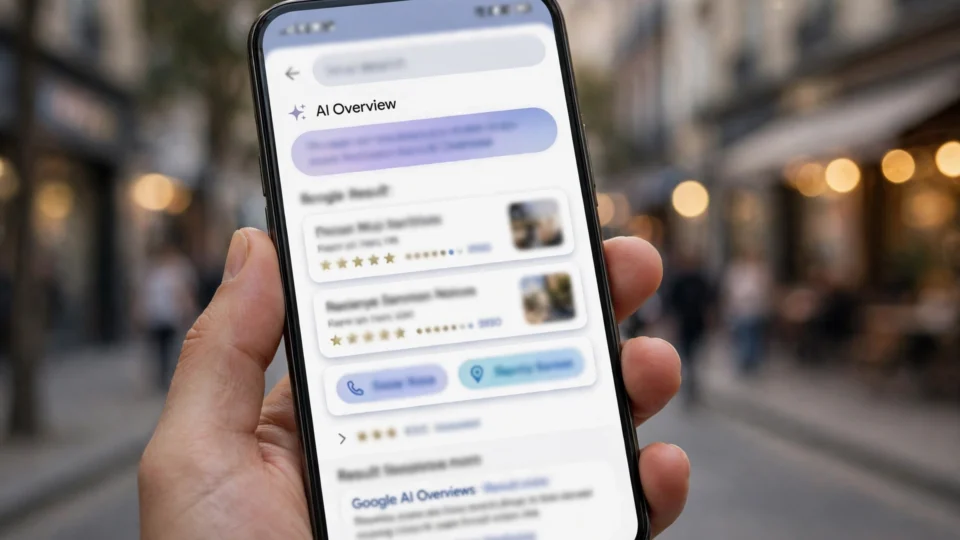
Shah paired the referral figure with a second number from Google Search Console. The company’s digital media sites generated about 2.7 billion impressions inside Google’s AI features — AI Overviews and AI Mode — during the same quarter, nearly 10 times the clicks those same sites received from Google Search, based on his estimates. The contrast is the story in miniature: Ziff Davis content was shown inside AI answers billions of times, while the visits those answers produced fell sharply.
How big is the decline over two years?
The 37% drop is the second year of a steep slide. Shah told analysts that referrals fell about 23% in the same quarter last year, putting the two-year decline at more than 50%: third-quarter organic referrals in 2026 were roughly half their 2024 level.
That compounding matters because it changes the shape of the problem. A single bad quarter can be blamed on an algorithm update or a seasonal swing. Two consecutive years of double-digit decline, each worse than the last, looks like a structural shift in how search sends traffic to publishers — and Shah’s own framing confirms it. He referred to “the disruption of search traffic by Google and LLMs” as a clear business headwind, and said the company expects referrals to keep falling.
The financial results tell the same story. Third-quarter revenue fell 5.6% to $289.3 million — a smaller drop than the traffic decline, which Shah attributed to businesses that do not rely on Google traffic, such as subscriptions and apps. The parts of Ziff Davis that do not depend on search held the overall result up while the search-dependent parts fell. A site with no subscriptions, apps or direct audience has no such cushion.
What does the 2.7 billion AI impressions figure actually measure?
The 2.7 billion figure is the most quoted number from the call, and also the most easily misunderstood. Shah said an impression is a count of how many times a link to a page was shown inside generative AI features, and that the figure comes from Search Console. Google’s help pages confirm the generative AI report counts how often links to a site appeared in AI Overviews and AI Mode.
Three things about that figure need to be understood before anyone uses it:
- Impressions are not visits. Being shown inside an AI answer is not the same as being clicked.
- The ratio is not a click-through rate. Shah compared AI-feature impressions with all clicks from Google Search — not with clicks from AI features alone. As of November 8, Google documents no separate AI click count.
- AI impressions are a subset of total search impressions. The generative AI report draws from the web search data in the main Performance report, so AI appearances sit inside the site’s overall search impression figures.
The honest reading is narrower than the headline suggests. Ziff Davis content was surfaced inside AI answers about 2.7 billion times in one quarter, while its Google referrals fell 37%. The figures do not prove that AI Overviews or AI Mode caused the referral decline — but they do prove that enormous AI visibility did not protect the publisher’s traffic. Being cited by AI is not the same as being visited.
Why did the Ziff Davis organic referrals fall?
No single cause has been proven, and anyone who claims otherwise is guessing. Several forces are pushing in the same direction, and Ziff Davis’s own disclosures point to the main ones.
First, AI answers now sit between the searcher and the publisher. When Google’s AI Overviews appear on a large share of the queries that matter, many searchers get their answer without clicking through. In August, Shah said AI Overviews appeared on about 50% of the queries relevant to Ziff Davis’s properties, up from about 36% when he last gave the figure.
Second, the decline is not spread evenly. Shah said the company’s tech and shopping brands “continue to face the strongest search traffic headwinds in our portfolio”. Tech and shopping revenue declined 3.8% year over year to $82 million, although the decline has narrowed for three consecutive quarters. Product comparisons, buying guides and tech explainers are exactly the query types where an AI summary can answer the question well enough that the searcher never clicks.
Third, some content is holding up better than the average, and the reason is instructive. Shah said Ziff Davis’s largest property by search referrals, IGN, has continued to hold up relatively well. He explained that much of its search referral traffic is around game help, which is very maps-heavy and difficult to duplicate — and that IGN also receives a significant amount of direct traffic. Content that is hard for an AI to reproduce, and an audience that comes directly rather than through search, are both shields against referral decline.
What held up, and what did not?
| Part of the business | What happened in Q3 2026 | What it suggests |
|---|---|---|
| Organic Google referrals (all digital media) | Down about 37% year over year | Search traffic is falling structurally, not seasonally |
| Organic referrals, Q3 last year | Down about 23% year over year | Two-year decline of more than 50% |
| AI Overviews and AI Mode impressions | About 2.7 billion in the quarter | Huge AI visibility — not equal to visits |
| Overall revenue | Down 5.6% to $289.3 million | Diversified income cushioned the traffic fall |
| Tech and shopping revenue | Down 3.8% to $82 million | Strongest headwinds; decline narrowing |
| Gaming and entertainment revenue | Down 2.1% | Weak gaming ad market ahead of a major game release |
| IGN (largest property by search referrals) | Held up relatively well | Hard-to-duplicate content and direct traffic protect it |
Two details in the call deserve attention. The first is the response: Ziff Davis is leaning into social commerce and the relaunched RetailMeNot app, and Shah said making money from the company’s content in AI answers was “the priority”, with licensing agreements on the table. The company is also waiting for clarity from its pending litigation against OpenAI — in Shah’s words, “there is a gap between usage and monetization”. The second is the measurement gap: the UK’s Competition and Markets Authority has set a December 3 deadline for Google to give publishers impressions, clicks and click-through rate for AI search features in the UK. If Google reports AI clicks separately, publishers will finally be able to line up AI impressions with AI clicks.
What does the Ziff Davis organic referrals decline mean for link building?
The Ziff Davis organic referrals decline does not mean link building is dead — it means the job description has changed. The old model was simple: earn links, improve rankings, collect the clicks that rankings produce. That model assumed search would keep sending traffic to the pages that rank. Ziff Davis is now telling the market that assumption no longer holds, and a link builder who keeps optimising only for rankings is optimising for a channel that is shrinking.
What changes, in practice, is what a good placement is worth. A link has always had two values: the authority it passes and the traffic it sends directly. AI search adds a third — whether the linked page is cited inside AI answers. The Ziff Davis numbers add a warning about that third value: citations alone do not guarantee visits. A placement on a site that appears in AI Overviews is valuable only if the page it links to is worth clicking through to — a page that answers the question directly, then goes deeper than the AI summary did. Our earlier analysis of the Zyppy experiment reached a similar conclusion: on one site, Google AI features sent an estimated 21% of its clicks. AI citations can send real traffic, but only to pages that earn the click. See our full breakdown of the Zyppy experiment and what AI features are worth in clicks.
There is also a defensive lesson. The sites that held up best were the ones with direct traffic and hard-to-duplicate content. Links should therefore do more than lift a page’s ranking — they should build the brand’s direct audience. A guest post that introduces a brand to a new audience, or a citation that makes a searcher remember a name, survives a referral decline because it does not depend on Google sending the next click.
How should link builders change their playbook?
The shift is practical. Here is a five-step version of it, drawn from what the Ziff Davis numbers actually show:
- Judge placements by citation potential, not just domain authority. Ask whether the host site’s pages show up in AI Overviews and AI Mode — a placement on a site AI features cite puts your brand inside the AI answer itself.
- Write linked pages that deserve the click. Lead with a direct answer an AI can quote, then go deeper than the summary — original data, a framework, a checklist. If the AI answer fully replaces your page, the placement’s traffic value is close to zero.
- Target content AI cannot easily reproduce. Follow the IGN lesson: maps, original research, hands-on testing and first-hand experience are hard to summarise away. Generic explainers are the most exposed content on the web.
- Build brand search and direct traffic alongside links. A brand people search for by name and return to directly is insulated from referral declines in a way a purely ranking-dependent site is not.
- Measure AI visibility next to rankings. Track which of your pages appear in AI features, and whether clicks on those pages move with that visibility. Our guide to how to measure AI visibility covers the reporting that exists today — including the fact that Google still reports no separate AI click count.
None of this means abandoning classic link building. Links still matter for AI search: the pages AI systems cite tend to be pages that other reputable sites link to, and our article on whether traditional link building is dead covers that evidence in detail. What changes is the goal: a link is no longer just a vote for a ranking; it is a route into an AI answer, a referral visit and a brand memory.

When should you hire a service like VonixCo?
Hire help when the shift above is more than your team can do consistently: earning placements on niche-relevant sites whose pages AI features cite, writing guest posts direct enough to be quoted and deep enough to be worth clicking, and tracking whether those placements show up in AI answers as well as in rankings. One guest post is easy; a steady programme on the right sites takes a team and a process.
VonixCo is a niche-relevant guest posting and SaaS link building service based in Lahore, Pakistan. Its services are SaaS guest posts, niche guest posts, link building and guest post content writing, with plans at $500, $950 and $1,800 per month, content included and a live link report with every placement. Contact: info@vonixco.com and WhatsApp +92 340 0096621.
If your needs are simple — a few placements on relevant sites, a few pages rewritten so AI systems can cite them — do that work yourself this week. Bring in a service when volume, consistency or outreach grows beyond what your team can sustain. And keep the Ziff Davis caveat in mind: a publisher’s 37% decline is a warning about dependence on search, not a promise about your site’s future. No honest provider can guarantee how much search or AI traffic your site will receive.
Frequently asked questions
What is the Ziff Davis organic referrals decline?
Ziff Davis reported that organic Google referrals to its digital media properties fell about 37% year over year in the third quarter of 2026. CEO Vivek Shah disclosed the figure on the company’s November 6 earnings call, adding that referrals had fallen about 23% in the same quarter a year earlier.
Is Ziff Davis planning on a search recovery?
No. Shah said the company is “not planning on a search recovery” and expects referrals to keep falling. That is a planning assumption, not a prediction about the whole industry — but it shows how a major publisher now treats declining search referrals: as a condition to plan around.
What does the 2.7 billion AI impressions figure mean?
It counts how many times links to Ziff Davis pages were shown inside Google’s AI Overviews and AI Mode during the quarter, according to Search Console’s generative AI report. It is an appearance count, not a visit count.
Did AI Overviews cause the 37% drop?
The reported figures do not prove that. The 37% decline is an aggregate change across a portfolio, and no experiment separated AI features from ranking changes, search demand or user behaviour. Shah called “the disruption of search traffic by Google and LLMs” a business headwind — but correlation is not causation.
Which parts of Ziff Davis held up best?
IGN, the company’s largest property by search referrals, held up relatively well — Shah linked that to its game-help content being maps-heavy and hard to duplicate, plus significant direct traffic. Tech and shopping brands faced the strongest search headwinds, with revenue down 3.8% to $82 million, though that decline has narrowed for three consecutive quarters.
What should link builders do differently after this news?
Choose placements partly by whether the host site’s pages appear in AI features, write linked pages that answer directly and then go deeper than the AI summary, target content AI cannot easily reproduce, and build brand search and direct traffic alongside links. Measure AI visibility next to rankings — citations that never earn a click are impressions, not visitors.