

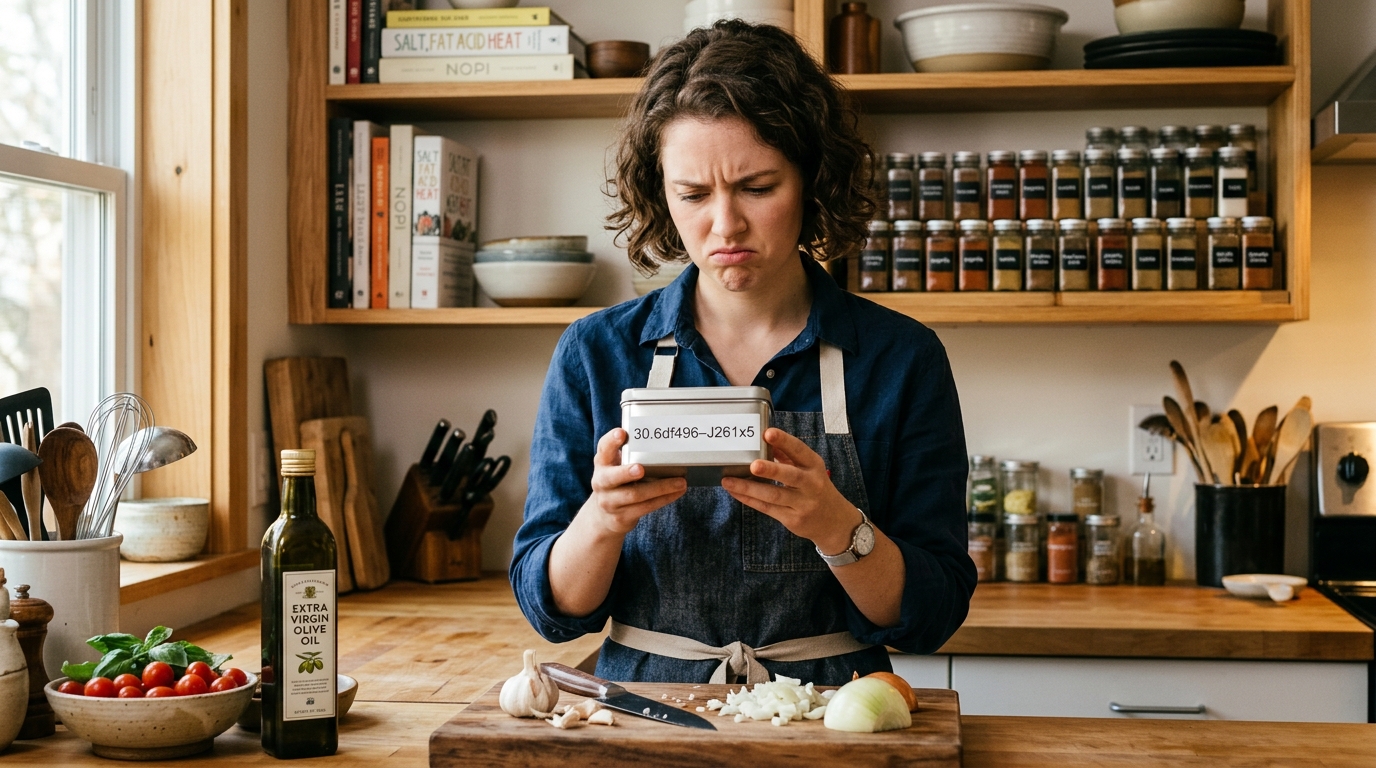
Introduction: The Question Everyone Is Googling
You typed it into a search bar — “can I cook with 30.6df496–J261x5” — and now you’re here, looking for a real answer. Maybe you spotted this strange code on a product label, found it referenced in a technical manual, or came across it in an online forum. Whatever brought you to this question, you deserve a clear, honest, and well-researched answer.
So let’s cut straight to it: 30.6df496–J261x5 is not a food ingredient. It is not a spice, an additive, a supplement, a cooking oil variety, or a culinary technique. It is an alphanumeric code — the kind used in technical databases, product catalogs, component registries, or software versioning systems.
But the fact that thousands of people are searching for this query tells us something important: there is genuine confusion, and that confusion deserves to be addressed carefully. In this article, we will break down exactly what this code looks like structurally, what kinds of systems use codes like this, why people are searching for it in a cooking context, and what food-safe alternatives you should actually be looking for when cooking.
Stick with us — by the end of this article, you will not only understand what 30.6df496–J261x5 is (and isn’t), but you will also come away better informed about how to identify real food-grade ingredients and avoid potentially dangerous kitchen mistakes.
What Is 30.6df496–J261x5? Breaking Down the Code
Before answering whether you can cook with something, you need to understand what that something actually is. Let’s analyze the structure of 30.6df496–J261x5.
Structural Anatomy of the Code
| Segment | Type | Likely Meaning |
|---|---|---|
| 30.6 | Numeric prefix | Version number, specification revision, or batch series |
| df496 | Alphanumeric | Hexadecimal-style identifier — common in software, hardware, and database entries |
| – | Separator dash | Standard separator in product part numbers and technical codes |
| J261x5 | Alphanumeric suffix | Component class, model sub-type, or catalog variant code |
When you see a code structured like this — with numeric decimals, lowercase hexadecimal-style characters, dashes, and uppercase-letter-prefixed suffixes — you are almost certainly looking at one of the following:
- A software build version or commit hash reference
- An industrial component part number
- A product serial code in a manufacturing database
- A technical specification identifier (like an ISO or DIN subcode)
- A firmware or hardware revision marker
None of these have anything to do with food, cooking, or culinary arts. Real food ingredient codes look entirely different — and we will discuss that in a later section.
Why Are People Searching “Can I Cook With 30.6df496–J261x5”?
This is a fair and interesting question. Why would someone connect an obviously technical code with cooking? There are several plausible explanations:
1. Product Label Confusion
Sometimes people purchase kitchen appliances, chemical cleaning solutions, food-safe packaging materials, or industrial equipment with long alphanumeric codes printed prominently on the label. If someone sees “30.6df496–J261x5” on a container and cannot immediately identify what it contains, their natural instinct might be to search whether it is safe to use in food preparation.
2. SEO Experiments and Trending Searches
It is also possible that this specific string became a trending or curiosity-driven search query. The internet is full of mysterious alphanumeric strings that gain attention simply because they look unusual and are hard to parse. People search to satisfy curiosity — and when enough people search the same unusual phrase, articles get written about it.
3. Copy-Paste Errors and Misread Labels
Another common scenario: someone was looking up a legitimate food additive code (like E-numbers in Europe, INS numbers globally, or FDA ingredient identifiers) and accidentally copied or typed the wrong string. These kinds of errors happen frequently.
4. Technical Documentation Overlap
In some industrial food processing environments, machinery part numbers and ingredient batch codes exist in the same documentation. A non-specialist reading through such a document might confuse a machinery component code for a food ingredient reference.
Regardless of the reason you found yourself searching this query, the answer remains the same: 30.6df496–J261x5 is not something you can or should cook with.
How Real Food Ingredient Codes Actually Look
To help you avoid future confusion, it is worth understanding how legitimate food ingredients and additives are actually coded and labeled.
E-Numbers (European Union)
In the EU, food additives are assigned E-numbers — simple codes starting with the letter “E” followed by three or four digits. These are strictly regulated by the European Food Safety Authority (EFSA).
Examples:
- E100 — Curcumin (natural yellow color from turmeric)
- E330 — Citric acid (common preservative and flavor enhancer)
- E471 — Mono- and diglycerides (emulsifiers in baked goods)
INS Numbers (International)
The International Numbering System (INS), maintained by the Codex Alimentarius Commission (a joint body of WHO and FAO), assigns numeric codes to food additives internationally.
Examples:
- INS 202 — Potassium sorbate (preservative)
- INS 412 — Guar gum (thickener)
- INS 621 — Monosodium glutamate (MSG, flavor enhancer)
FDA GRAS Codes (United States)
In the United States, the FDA maintains a list of substances “Generally Recognized As Safe” (GRAS). These are not assigned simple alphanumeric codes like E-numbers but are instead identified by their chemical or common names.
CAS Numbers (Chemical Abstracts Service)
For food-grade chemicals and pure compounds, the CAS number system is widely used. These look like: 64-17-5 (ethanol), 57-50-1 (sucrose), 7647-14-5 (sodium chloride/table salt).
Notice the key differences: real food codes are simple, standardized, and follow internationally recognized formats. 30.6df496–J261x5 fits none of these formats. It does not resemble an E-number, an INS number, a CAS number, or any FDA food identifier.
The Danger of Cooking With Unidentified Substances
This may seem like an obvious point, but it is critically important: never cook with or consume any substance if you cannot positively identify it as food-safe.
This principle matters more than ever in an age when:
- Industrial chemicals are sometimes stored in unlabeled or mislabeled containers
- Online misinformation can lead people to experiment with non-food substances
- Products meant for industrial or technical use can physically resemble food-grade items
Potential Risks of Ingesting Non-Food Substances
Depending on what a technical substance actually is, consuming it could lead to:
Short-term risks:
- Nausea, vomiting, and diarrhea
- Chemical burns to the mouth, throat, or digestive system
- Allergic reactions or anaphylaxis
Long-term risks:
- Organ damage (particularly liver and kidneys)
- Neurological effects from heavy metals or solvents
- Carcinogenic exposure from industrial compounds
If you have encountered an unlabeled or strangely labeled substance in your kitchen or food preparation area and are uncertain about its safety, do not taste, smell closely, or cook with it. Contact Poison Control (in Pakistan: 042-35761999 or 1122) or your local health authority for guidance.
What Should You Actually Cook With? A Guide to Safe Ingredients
Since 30.6df496–J261x5 is off the table (literally and figuratively), let us redirect this energy toward what you should be cooking with. Here is a brief guide to safely identifying food-grade ingredients.
Reading Food Labels Correctly
When purchasing ingredients, look for:
- Clear common name (e.g., “table salt,” “sunflower oil,” “baking soda”)
- Ingredients list following standard food labeling regulations
- Nutritional information panel
- Country-specific certification marks (e.g., Halal certified in Pakistan)
- Expiry date and batch number in a standard format (DDMMYY or similar)
Trusted Ingredient Categories
Whole foods: Vegetables, fruits, grains, legumes, meat, fish, dairy — these need no code to identify.
Packaged spices and condiments: Should list both the common name and any additives by their E-number or INS number.
Specialty food additives (for home baking/cooking):
- Baking powder — contains sodium bicarbonate and cream of tartar
- Xanthan gum — listed by name, often with INS 415
- Food-grade colorings — listed by E-number or name
When in Doubt, Check These Resources
- Pakistan Standards and Quality Control Authority (PSQCA): www.psqca.com.pk
- WHO Codex Alimentarius: www.fao.org/fao-who-codexalimentarius
- FDA Ingredient Glossary: www.fda.gov
Could 30.6df496–J261x5 Be a Cooking Equipment Code?
One angle worth exploring: could this code be related to a piece of cooking equipment rather than an ingredient?
It is possible. Many kitchen appliances — commercial ovens, food processors, refrigeration units, industrial mixers — carry long part numbers that include version identifiers and model codes. If 30.6df496–J261x5 appeared on a piece of kitchen machinery or one of its components, the question “can I cook with” it might make more sense as: “Is this appliance safe to use for cooking?”
In that case, you would want to:
- Locate the full model number on the device’s data plate (usually on the back or bottom)
- Search the manufacturer’s website for documentation matching that code
- Check whether the device carries food-safe certifications (e.g., NSF International certification for commercial kitchen equipment)
- Contact the manufacturer directly if documentation is unclear
Even as an equipment code, 30.6df496–J261x5 does not match any known major kitchen appliance brand’s standard naming convention — but it could belong to a niche or industrial supplier.
SEO Insight: What This Search Trend Tells Us About Consumer Behavior
From an SEO and consumer psychology perspective, the popularity of the query “can I cook with 30.6df496–J261x5” is a fascinating case study.
It reflects a broader behavior pattern: when people encounter something unfamiliar in or near their food environment, they instinctively turn to search engines. This is actually a healthy and smart behavior — but it highlights the importance of:
- Clear product labeling — manufacturers have a responsibility to make their products’ contents and purposes unmistakably clear
- Digital literacy around codes — consumers benefit from knowing how to distinguish technical codes from food identifiers
- Accessible information — government and health agencies should make food additive databases easy to search and understand
If you are a food blogger, content creator, or business owner who stumbled across this query while doing keyword research, this is a reminder that people are curious, sometimes confused, and always looking for trustworthy guidance. Meeting them with honest, clear information builds lasting audience trust.
Common Myths About Strange Codes on Food-Adjacent Products
Let us debunk a few myths that might fuel confusion like this:
Myth #1: If it has a long code, it must be a regulated food additive. Truth: Long codes appear on everything from circuit boards to shipping containers. Food additives follow specific, internationally standardized numbering systems.
Myth #2: Industrial-grade substances in food-safe packaging are safe to eat. Truth: Packaging determines container safety, not contents. Always verify the substance itself, not just the container.
Myth #3: If something is sold near food products, it is food-safe. Truth: Supermarkets and general stores stock many non-food items alongside food. Proximity does not imply edibility.
Myth #4: Searching online for a code is enough to confirm food safety. Truth: Search results can be misleading or incomplete. For any genuine food safety question, consult official regulatory databases or a qualified food scientist.
Final Verdict: Can I Cook With 30.6df496–J261x5?
No. You cannot and should not cook with 30.6df496–J261x5.
This code is not a food ingredient. It is not a spice, an additive, an oil, a powder, or any culinary substance. It is a technical alphanumeric identifier — the kind found in software systems, industrial parts databases, and engineering documentation.
If you encountered this code in a food-related context:
- On a food product label: you may have misread the label. Look more carefully for the ingredient name or E/INS number.
- On a kitchen appliance: it is likely a model or component code — search the manufacturer’s site.
- On a chemical or cleaning product: keep it far from food and food preparation areas.
- In an online article or forum: treat it with skepticism and do not act on unverified information.
Your kitchen is a place of nourishment, creativity, and care. Protect it — and yourself — by only cooking with clearly identified, food-grade, properly labeled ingredients.
Frequently Asked Questions (FAQs)
Q: Is 30.6df496–J261x5 an FDA-approved food additive?
A: No. It does not match any format used in FDA food additive approvals. It is not listed in any food safety regulatory database.
Q: Could 30.6df496–J261x5 be a food colorant code?
A: No. Food colorants are identified by E-numbers (e.g., E102, E120) or by their chemical names. This code does not match that system.
Q: I found this code on a package in my kitchen. What should I do?
A: Check the full label carefully. If you cannot identify the substance inside, do not consume it. Contact the manufacturer or your local food safety authority.
Q: Are alphanumeric codes on food packaging always ingredient codes?
A: No. Food packaging often includes batch numbers, production line codes, machine codes, and barcodes that are not ingredient identifiers.
Q: What is the safest way to verify if an ingredient is food-safe?
A: Cross-reference the ingredient name with the WHO Codex Alimentarius, the FDA GRAS list, or your country’s national food authority database.
Conclusion
The search query “can I cook with 30.6df496–J261x5” may seem peculiar, but it represents something deeply human: the drive to understand the things around us, especially when it comes to what we put into our bodies. In that spirit, this article has given you a complete, honest, and thorough answer.
30.6df496–J261x5 is a technical code with no place in your kitchen. But the curiosity that led you here? That belongs everywhere. Keep asking questions, keep reading labels, keep verifying before you cook — and your kitchen will remain the safe, delicious haven it is meant to be.