

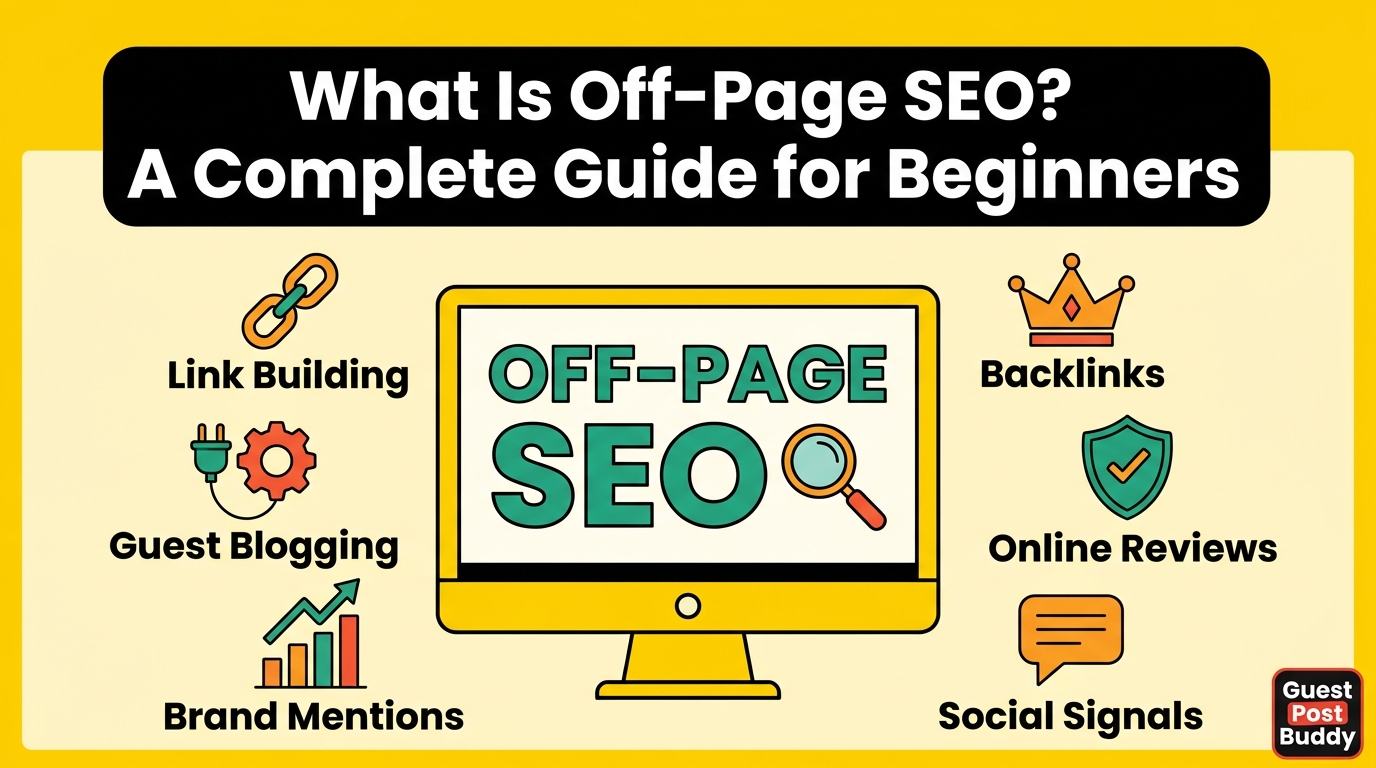
If you have ever built a website, written great content, and still wondered why Google does not rank you on the first page — you are not alone. Millions of website owners face the same problem every day. They focus entirely on what happens inside their website and completely ignore what happens outside it.
That outside work? It has a name. It is called Off-Page SEO.
In this guide, I am going to walk you through everything you need to know about off-page SEO — in plain, simple language that anyone can understand. Whether you are a blogger in Birmingham, a small business owner in Boston, or a freelancer just getting started with digital marketing, this guide is written for you.
Let us get into it.
What Is Off-Page SEO? (The Simple Explanation)
Off-page SEO refers to all the actions you take outside your own website to improve your rankings on search engines like Google and Bing.
Think of it this way.
Imagine you open a new coffee shop on the high street. You decorate it beautifully, write a great menu, and make the best coffee in town. That is your on-page SEO — everything inside your shop is perfect.
But if no one in the neighbourhood is talking about your coffee shop, recommending it to friends, or leaving reviews on Google Maps — your shop stays empty. The outside world does not know you exist.
Off-page SEO is the digital equivalent of people talking about your business, recommending it, linking to it, and vouching for its quality.
When other websites, people, and platforms mention and link back to your site, Google sees this as a vote of confidence. The more quality votes you collect, the more Google trusts you — and the higher you rank.
Why Does Off-Page SEO Matter So Much?
Here is something that surprises most beginners: Google’s algorithm uses over 200 ranking factors, and many of the most powerful ones are off-page signals.
Google’s original breakthrough — the PageRank algorithm — was built on one core idea: if many high-quality websites link to your page, your page must be trustworthy and valuable.
That idea has not gone away. It has only become more sophisticated.
According to industry studies, backlinks remain one of the top three ranking factors for Google. But off-page SEO today goes well beyond just building links. It includes your brand mentions across the internet, your reputation on social platforms, reviews on business directories, influencer endorsements, and much more.
Here is why this matters for you practically:
- Two websites with identical on-page SEO will not rank the same if one has more quality off-page signals than the other.
- You can write the most detailed article on a topic, but if no authoritative site links to it, Google may never rank it highly.
- Off-page SEO builds your Domain Authority (DA) — a score that reflects how trustworthy your overall website is. Higher DA means easier rankings across all your pages.
Simply put: without off-page SEO, you are fighting with one hand tied behind your back.
On-Page SEO vs Off-Page SEO: What Is the Difference?
Before we dive deeper, let us clear up one common point of confusion.
On-Page SEO = Everything you control on your website
- Your title tags and meta descriptions
- Your heading structure (H1, H2, H3)
- Your keyword usage in content
- Your internal links
- Your page speed and mobile-friendliness
- Your image alt text
Off-Page SEO = Everything that happens outside your website
- Backlinks from other sites pointing to yours
- Brand mentions across the web
- Social media signals and shares
- Guest posts on other blogs
- Reviews and ratings on third-party platforms
- Influencer endorsements
- Podcast appearances and features
- Forum discussions and community participation
Both matter. Think of on-page SEO as building a great product, and off-page SEO as marketing that product to the world.
The Core Components of Off-Page SEO
Now let us go through each major component in detail. I will explain what it is, why it matters, and how you can start doing it — even as a complete beginner.
1. Link Building (The Foundation of Off-Page SEO)
Link building is the process of getting other websites to link back to your website. These links are called backlinks or inbound links.
When a respected website links to yours, it is essentially telling Google: “We trust this website enough to send our readers there.”
Not all backlinks are equal. This is one of the most important things you need to understand.
A backlink from the BBC, The Guardian, or Forbes is worth hundreds of times more than a backlink from a random unknown blog.
Why? Because Google weighs the authority and relevance of the linking site. A link from a highly trusted, high-traffic website passes far more “link juice” (ranking power) to your site than a link from a site nobody knows or trusts.
Here are the main types of backlinks:
Do-Follow Links — These pass SEO value (link juice) from one site to yours. This is what you want most.
No-Follow Links — These tell Google not to pass SEO value. However, they still bring traffic and build brand awareness, so they are not worthless.
Editorial Links — These are links you earn naturally because someone found your content valuable. Google loves these the most.
Guest Post Links — Links you get by writing articles for other websites and including a link back to your own site.
Directory Links — Links from business directories like Yelp, Yell.com, or industry-specific directories.
2. Guest Blogging (Writing for Other Websites)
Guest blogging is one of the most effective and widely used off-page SEO strategies. Here is how it works:
You reach out to a website in your niche and offer to write a high-quality article for them — for free. In return, you get to include one or two links back to your own website within the article or in your author bio.
Why does this work?
- You get a quality backlink from a relevant, trusted site.
- You get exposure to a brand new audience who may then visit and follow your own website.
- You build relationships with other website owners and bloggers in your industry.
How to get started with guest blogging:
- Search Google for: your niche + “write for us” (e.g., “digital marketing write for us”)
- Find blogs that accept guest contributions and have decent authority.
- Read their existing content carefully.
- Pitch them a specific, original topic idea they have not covered yet.
- Write a genuinely helpful, well-researched article — not a thinly disguised advertisement.
One important note: guest blogging for SEO has been abused in the past. Google has cracked down on low-quality, spammy guest posts. The key is to contribute only to relevant, reputable websites with real audiences.
3. Brand Mentions (Even Without Links)
This one surprises many beginners.
Google is intelligent enough to recognise when your brand is mentioned online — even without a clickable link. These are called unlinked brand mentions and they still carry weight as off-page SEO signals.
Think about it from Google’s perspective. If thousands of people are writing about your brand across forums, social media, news articles, and review sites — even without linking to your website — Google interprets this as a sign that you are a real, trusted, talked-about brand.
How to get more brand mentions:
- Create content so useful and original that people naturally talk about it.
- Participate in industry events, webinars, or podcasts.
- Issue press releases when your business hits a milestone.
- Conduct original research or surveys that people cite and reference.
Pro tip: Set up Google Alerts for your brand name. Every time someone mentions your brand online, you will get a notification. You can then reach out to those sites and politely ask them to turn that mention into a clickable link — a technique called link reclamation.
4. Social Media Signals
Social media does not directly boost your Google rankings in the way backlinks do. Google has been clear that social media shares are not a direct ranking factor.
However, social media plays a massive indirect role in off-page SEO:
- When your content gets shared widely on Twitter (X), LinkedIn, Facebook, or Pinterest, more people see it — and some of those people are bloggers, journalists, or website owners who may then link to it.
- Social media drives referral traffic to your website, which signals to Google that your content is valuable.
- A strong social media presence builds brand awareness and trust — both of which contribute to your overall off-page authority.
Do not treat social media as an optional extra. Treat it as a distribution channel for your content and a way to build relationships in your industry.
5. Local Citations and Business Directories
If you run a local business — whether you are a plumber in Manchester, a restaurant in Chicago, or a dentist in Edinburgh — local citations are one of the most powerful off-page SEO tools you have.
A local citation is any online mention of your business name, address, and phone number (often called NAP). These citations appear on platforms like:
- Google Business Profile (formerly Google My Business)
- Yelp
- Yell.com (UK)
- TripAdvisor (for hospitality businesses)
- Facebook Business Pages
- Apple Maps
- Bing Places
Why do citations matter?
When Google sees your business name, address, and phone number consistently listed across trusted directories, it gains confidence that your business is real and legitimate. This is a key signal for ranking in local search results — the map listings that appear when someone searches “coffee shop near me” or “plumber in Leeds.”
Make sure your NAP is consistent everywhere. Even small differences — like abbreviating “Street” as “St.” on one listing and spelling it out on another — can confuse Google and weaken your local SEO.
6. Online Reviews and Reputation Management
Reviews are a form of off-page SEO that most small business owners underestimate.
When customers leave reviews on Google, Trustpilot, Yelp, or industry-specific platforms, these reviews:
- Build trust with potential customers who find you through search.
- Signal to Google that your business is active, legitimate, and valued by real people.
- Directly influence your rankings in local search results — Google explicitly uses review signals as a local ranking factor.
How to get more reviews:
- Simply ask your satisfied customers. Most people are happy to leave a review when asked directly after a good experience.
- Send a follow-up email with a direct link to your Google review page.
- Make the process as easy as possible — a QR code on your receipt or invoice works well for physical businesses.
How to respond to reviews:
Always respond to reviews — both positive and negative. Thanking people for positive reviews shows you value your customers. Responding professionally to negative reviews shows potential customers that you take concerns seriously and act on feedback.
7. Influencer Marketing and Digital PR
In the modern off-page SEO landscape, digital PR and influencer collaborations have become increasingly powerful tools.
Digital PR is the process of getting your brand, content, or research featured in online publications, news websites, and blogs. When a journalist writes about your business in a regional newspaper’s website, or a popular tech blog covers your new product — those are high-authority backlinks that money cannot easily buy through traditional outreach.
How do you earn these? By creating something genuinely newsworthy:
- Original research, data, or surveys
- Bold opinions on trending industry topics
- Unique tools or resources that journalists find useful to reference
- Compelling human interest stories about your business journey
Influencer marketing in the context of SEO means partnering with content creators in your niche who have audiences that trust them. When they mention your website, product, or content — their audiences visit you, and they often link to you in their blog posts, videos, or social content.
8. Forum Participation and Community Engagement
Before the social media era, forums were the internet’s communities. They still are — and they are still valuable for off-page SEO.
Platforms like Reddit, Quora, Stack Exchange, and niche-specific forums give you the opportunity to:
- Establish yourself as a knowledgeable expert in your field.
- Include links to your own content where genuinely relevant and helpful.
- Drive targeted traffic from people actively searching for answers you provide.
The golden rule here: add value first, promote second.
Never spam forums with links to your website. Instead, become a genuinely helpful participant. Answer questions thoroughly. When your own content is the most relevant resource for a question, include the link — but only when it truly helps the person asking.
Quora, in particular, can drive substantial organic traffic if you write detailed, helpful answers to questions in your niche. Answers that rank well in Google can send readers your way for years.
9. Podcast Appearances and Video Collaborations
One of the most underrated off-page SEO strategies for 2025 is appearing as a guest on podcasts.
Here is why: almost every podcast episode gets a dedicated web page with show notes. That show notes page typically includes links to the guest’s website. These are editorial, contextual backlinks from relevant, trusted media sites.
Beyond the backlink, a podcast appearance puts you in front of a highly engaged, niche audience — exactly the kind of people who might bookmark your website, share your content, and buy from you.
The same logic applies to YouTube collaborations, joint webinars, and co-hosted live sessions.
If you are an expert in your field, start pitching yourself as a guest to podcasts in your industry. You will be surprised how open many podcast hosts are to relevant, knowledgeable guests.
What Makes a Good Backlink?
Now that you understand the main off-page SEO strategies, let us talk about link quality — because not all backlinks help you, and some can actually hurt you.
Here is what makes a backlink valuable:
Relevance — A link from a website in your niche carries far more weight than a random link from an unrelated site. If you run a fitness blog, a backlink from a health magazine is far better than one from a car parts website.
Authority — Links from high-authority, high-traffic websites pass more ranking power. Tools like Ahrefs, Moz, or Semrush can show you a website’s Domain Authority or Domain Rating score.
Placement — A link embedded naturally within the body of an article is more valuable than a link tucked away in a footer or sidebar.
Anchor Text — The clickable text of the link (called anchor text) matters. A link that says “best running shoes for beginners” is more meaningful to Google than one that just says “click here.”
Traffic — A backlink from a website that gets real human traffic is more valuable than one from a dead website nobody visits.
Common Off-Page SEO Mistakes to Avoid
As you begin your off-page SEO journey, watch out for these mistakes that can actively harm your rankings:
Buying backlinks — Google’s guidelines strictly prohibit paid link schemes. Websites that sell links risk penalties that can wipe them from search results entirely. Avoid these at all costs.
Getting links from irrelevant sites — Hundreds of links from irrelevant, low-quality sites are worth far less than a handful of links from trusted, relevant ones.
Ignoring anchor text diversity — If every backlink to your site uses the exact same keyword phrase as anchor text, it looks unnatural to Google. Aim for a natural mix of branded anchors, keyword anchors, and generic anchors.
Using Private Blog Networks (PBNs) — Some people build networks of fake websites just to link to their main site. Google actively hunts these down and penalises sites involved with them.
Neglecting disavow — If you notice a flood of spammy, low-quality links pointing to your website (sometimes from competitors trying to harm you), use Google’s Disavow Tool to tell Google to ignore those links.
How to Measure Your Off-Page SEO Progress
You cannot improve what you do not measure. Here are the key metrics to track your off-page SEO progress:
Domain Authority / Domain Rating — Use free tools like Moz’s Link Explorer or Ahrefs’ free tools to track your overall site authority score over time. This should grow steadily as you earn more quality backlinks.
Number of Referring Domains — This counts how many unique websites link to you. Generally, more referring domains = more trust from Google. Track this monthly.
Backlink Profile — Use tools like Ahrefs, Semrush, or the free Google Search Console to see exactly which sites are linking to you, which pages they link to, and what anchor text they use.
Organic Search Traffic — Ultimately, the goal of all your off-page SEO work is to rank higher and get more visitors from Google. Track your organic traffic in Google Analytics or Search Console.
Brand Mention Volume — Use Google Alerts or a tool like Mention.com to track how often your brand is being discussed online.
A Simple Off-Page SEO Action Plan for Beginners
Feeling overwhelmed? Do not be. Here is a simple, practical action plan to start your off-page SEO journey today:
Week 1–2: Audit and Set Up
- Set up Google Search Console and Google Analytics on your website.
- Claim your Google Business Profile (critical for local businesses).
- Set up Google Alerts for your brand name.
- Check your current backlink profile using a free tool.
Week 3–4: Directory Listings
- Submit your website to the top 10–15 relevant business directories.
- Ensure your NAP is consistent across all listings.
Month 2: Content and Outreach
- Create one truly outstanding, in-depth piece of content (a guide, a study, or a tool).
- Identify 10–15 relevant blogs or websites in your niche.
- Begin personalised outreach, offering guest posts or collaboration.
Month 3 and Beyond: Consistent Building
- Publish one guest post per month on a relevant, authoritative site.
- Engage weekly on Quora or Reddit in your niche.
- Respond to all reviews on Google and Yelp.
- Pitch yourself to two or three podcasts in your industry.
- Share all new content on your social media channels.
Consistency is the key to off-page SEO. It is not a sprint. It is a long game that rewards those who show up and keep building — month after month.
Final Thoughts: Off-Page SEO Is About Trust
After everything I have covered in this guide, I want to leave you with one simple truth:
Off-page SEO is fundamentally about building trust.
Google wants to rank websites that real people trust, talk about, and recommend. Every backlink is a recommendation. Every brand mention is a conversation about you. Every review is a testimonial. Every podcast appearance is someone vouching for your expertise.
The websites that win at off-page SEO are not the ones gaming the system with tricks and shortcuts. They are the ones consistently creating value, building genuine relationships, and earning their reputation — one link, one mention, one review at a time.
Start where you are. Use the strategies in this guide. Be patient and consistent. The results will come.
If you found this guide helpful, share it with someone who is just starting their SEO journey. That is, after all, what off-page SEO is all about — people sharing what is genuinely useful.