

Introduction: The Keywords Nobody Talks About (But Everyone Should Be Using)
Let me ask you something honest.
Have you ever spent weeks writing what you thought was a great piece of content, published it, and then… nothing? No traffic. No clicks. No rankings. Just silence.
If that sounds familiar, there is a very good chance you were targeting the wrong keywords.
Most beginners — and even some experienced marketers — go after the big, flashy keywords. Things like “lose weight” or “make money online” or “best shoes.” These keywords get thousands of searches every single day. The logic feels right: more searches should mean more traffic, right?
Not quite.
Those keywords are a battlefield. The biggest brands, the oldest websites, and the most well-funded companies in the world have been fighting over them for years. As a smaller website, trying to rank for “shoes” is like showing up to a boxing match against a heavyweight champion. You might be technically right to be there, but you are not going to win.
This is exactly where long-tail keywords come in — and they are one of the most underrated, most powerful tools in SEO that can actually work for you, regardless of the size of your website or your marketing budget.
In this guide, written from years of experience working with content strategies across the UK and the US, we are going to break down everything you need to know about long-tail keywords. What they are, why they work, how to find them, and how to use them to actually grow your website traffic with real, interested visitors.
Let us get into it.
What Exactly Are Long-Tail Keywords?
A long-tail keyword is a search phrase that is longer, more specific, and more detailed than a typical broad keyword.
Instead of searching for “coffee,” someone might search for “best dark roast coffee for a French press at home.” Instead of “running shoes,” they might type “lightweight running shoes for flat feet women size 8.”
The phrase “long-tail” actually comes from a statistical concept. If you imagine a graph plotting every keyword by how many searches it gets, the most popular keywords sit at the top like a big head — a huge spike. As you move along the graph, the keywords become less popular but far more numerous. This trailing end of the graph is what people call the “long tail.”
Here is the key insight: while each individual long-tail keyword gets fewer searches than a broad keyword, the total volume of all long-tail searches combined is enormous. In fact, studies have consistently shown that long-tail keywords make up somewhere between 70 and 92 percent of all searches on the internet. That is the vast majority of what people are actually typing into Google every day.
So when people say “nobody searches for long-tail keywords,” they are completely wrong. Everyone searches for long-tail keywords. They just do not always realise it.
Short-Tail vs Long-Tail: The Simple Difference
To make this crystal clear, here is a quick side-by-side:
| Short-Tail Keyword | Long-Tail Keyword |
|---|---|
| Coffee | Best dark roast coffee for French press |
| Shoes | Lightweight running shoes for flat feet women |
| Diet | How to lose weight without going to the gym |
| Laptop | Best budget laptop for college students under 500 pounds |
| SEO | How to do keyword research for a small business blog |
The pattern you will notice is that long-tail keywords answer a question, describe a situation, or target a very specific type of person. They are phrases that real people type when they are looking for something specific — and that specificity is exactly what makes them so valuable.
Why Long-Tail Keywords Work So Well
Now that you know what they are, let us talk about why they actually work. Because this is not just theory — there are very concrete, practical reasons why long-tail keywords deliver results.
1. Less Competition Means You Can Actually Rank
This is the most straightforward reason and the one that matters most if you have a newer or smaller website.
When you target a broad keyword like “weight loss tips,” you are competing against sites like Healthline, WebMD, the NHS website, Men’s Health, and thousands of other established domains with millions of backlinks and years of authority behind them. Google has no real reason to rank you above them.
But when you target “how to lose weight with a desk job in your 40s,” the competition drops dramatically. There are fewer pages targeting that exact phrase. The ones that do exist are often thinner, less focused pieces of content. Suddenly, a well-written, helpful article on your site has a genuine chance of ranking on the first page of Google.
This is not a trick or a shortcut. It is simply smart competition. You are choosing the right battles to fight.
2. Long-Tail Searchers Are More Ready to Act
Here is something that many people miss: the person typing a long-tail keyword is almost always further along in their decision process than the person typing a short keyword.
Think about it this way. If someone types “coffee” into Google, what do they want? Who knows. Maybe they want to know the history of coffee. Maybe they want a recipe. Maybe they are just vaguely curious. The search intent is incredibly broad and unclear.
But if someone types “buy Ethiopian single origin coffee beans online UK,” you know exactly what they want. They want to buy coffee. They know what kind. They know where they are. They are ready to spend money.
This is called search intent, and it is one of the most important concepts in modern SEO. Long-tail keywords almost always carry much stronger and clearer intent than short keywords. And that means the visitors you get from long-tail searches are far more likely to do whatever it is you want them to do — subscribe to your list, buy your product, book your service, or engage with your content.
In the SEO world, we call this conversion rate. And long-tail keywords consistently produce higher conversion rates than their broader counterparts.
3. They Help You Build a Content Strategy That Covers Real Topics
When you start researching long-tail keywords properly, something interesting happens. You start to see all the specific questions, worries, and needs that people in your niche actually have.
This gives you an almost unfair advantage in content planning. Instead of guessing what to write about, you are simply answering the questions that real people are already asking. Your content becomes genuinely useful rather than a vague overview of a topic.
Over time, as you write articles targeting dozens of related long-tail keywords in the same topic area, Google begins to recognise your site as an authority on that subject. This is what SEO professionals call topical authority, and it is one of the most powerful ways to grow organic traffic in 2025.
4. They Future-Proof You Against Algorithm Changes
Google updates its algorithm constantly — sometimes hundreds of times a year. Sites that rely on a handful of high-volume keywords are extremely vulnerable to these changes. If Google decides to shuffle the rankings for “best diet tips” and you drop from position two to position twelve, your traffic could crash overnight.
But if your traffic comes from hundreds of long-tail keywords spread across dozens of articles, no single algorithm update can wipe you out. You are diversified. You are resilient.
This is another reason why experienced SEOs focus heavily on long-tail keyword strategies rather than chasing after the biggest possible keywords.
The Three Types of Long-Tail Keywords You Should Know
Not all long-tail keywords are created equal. It helps to understand the different categories so you can use them in the right way.
Informational Long-Tail Keywords
These are questions and research-driven searches. The person wants to learn something.
Examples:
- “How does compound interest work for beginners”
- “What causes lower back pain when sitting”
- “Why is my sourdough bread too dense”
These are perfect for blog posts, how-to guides, and educational content. They help you attract visitors in the early stages of their journey.
Commercial Long-Tail Keywords
These are searches where someone is comparing options or getting ready to buy.
Examples:
- “Best standing desk under 300 dollars for home office”
- “Ninja vs Vitamix blender comparison”
- “Top rated accountants in Manchester for small businesses”
These work brilliantly for comparison articles, product reviews, roundup posts, and service pages.
Transactional Long-Tail Keywords
These are searches with very clear buying intent. The person has decided they want something — they are looking for where to get it.
Examples:
- “Buy noise cancelling headphones Sony UK free delivery”
- “Book a plumber in Birmingham same day”
- “Download SEO course for beginners free”
These are the keywords you want on your product pages, landing pages, and service pages. They may not get huge volumes but the people arriving on those pages are ready to convert.
How to Find Long-Tail Keywords: Practical Methods That Actually Work
Let us get into the practical side of things. Here are the methods that work best for finding long-tail keyword opportunities.
Method 1: Google’s Autocomplete Feature
This is free, real-time, and incredibly powerful. Go to Google, start typing your main topic, and do not press Enter. Watch what Google suggests as you type.
These suggestions are based on what real people are actually searching for. They are pure gold for long-tail keyword research.
Try typing your topic and then adding words like “for,” “how,” “best,” “without,” “with,” “near me,” or letters of the alphabet. You will uncover dozens of keyword ideas in just a few minutes.
Method 2: People Also Ask and Related Searches
When you do search for a broad keyword on Google, scroll down the results page. You will see two incredibly useful sections:
The “People Also Ask” box shows you questions that people commonly ask related to your keyword. Each question is essentially a long-tail keyword waiting to be turned into a piece of content.
The “Related Searches” section at the bottom of the page gives you even more keyword variations and ideas.
Both of these features are free, require no tools, and are updated constantly by Google based on actual search behaviour.
Method 3: AnswerThePublic
AnswerThePublic is a tool that takes any keyword and shows you all the questions, comparisons, and related phrases people are searching for around that topic. It visualises this in a beautiful spider diagram and is available in both a free and paid version.
Even the free version gives you hundreds of long-tail keyword ideas in seconds. Type in your main topic and watch as questions beginning with who, what, where, when, why, how, can, will, and are all appear in front of you.
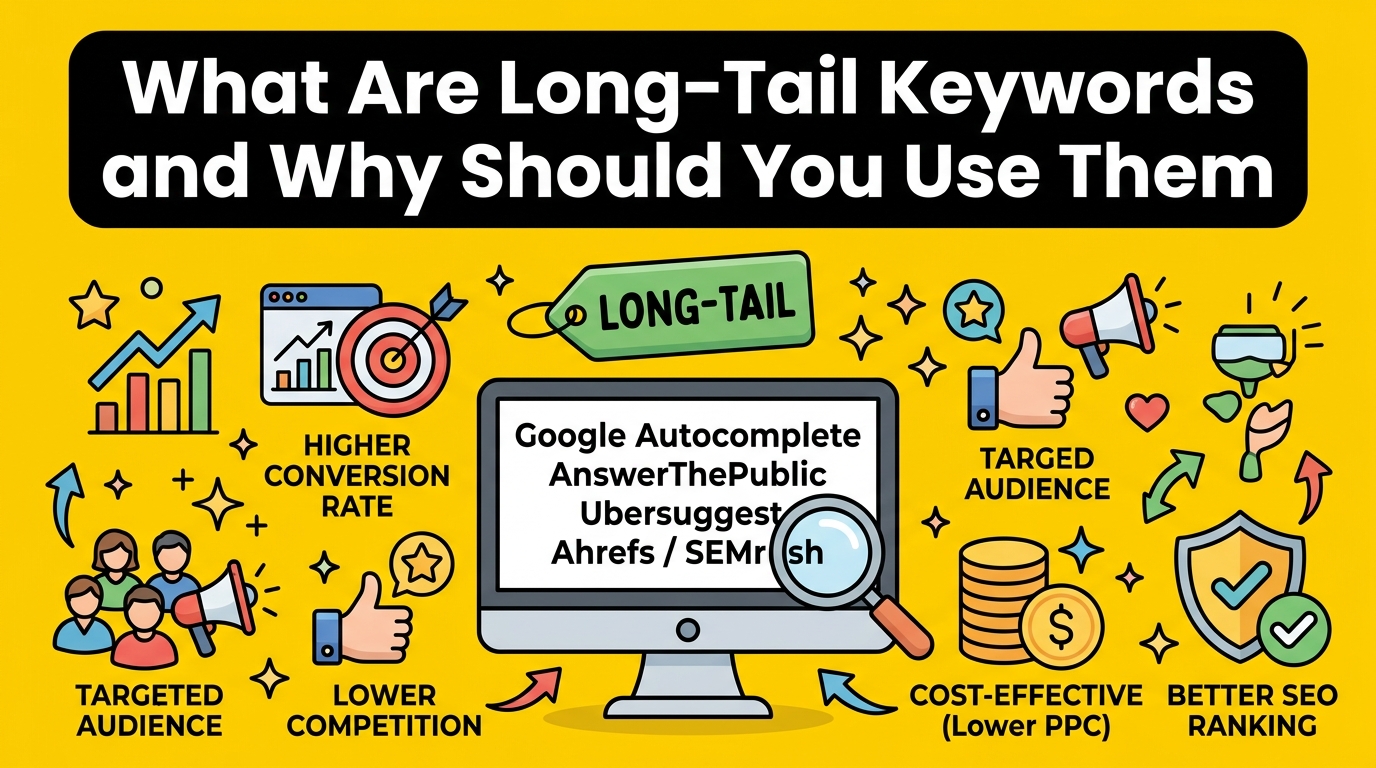
Method 4: SEO Tools — Ahrefs, SEMrush, and Ubersuggest
If you are serious about SEO and you have a budget for tools, platforms like Ahrefs and SEMrush have dedicated keyword explorers that allow you to filter by keyword length, search volume, and keyword difficulty.
The key feature to use is keyword difficulty filtering. Set it to show you keywords with a low difficulty score — ideally under 20 or 30 — and you will have a list of long-tail opportunities you can realistically rank for.
Ubersuggest, created by Neil Patel, offers a more affordable entry point with similar features and is very popular among bloggers and small business owners.
Method 5: Your Own Search Console Data
If your website has been live for any length of time, Google Search Console is showing you exactly what long-tail keywords people are already using to find your site — even if you are ranking on page four or five.
Log in, go to the Performance tab, and filter for queries with low average positions (anywhere from 11 to 50). These are your hidden gems. People are finding you for these terms, but you are not ranking highly enough to get the full benefit. Write dedicated content targeting those exact phrases and you can often get significant ranking improvements quickly.
How to Use Long-Tail Keywords in Your Content
Finding the keywords is only half the work. Here is how to use them effectively once you have your list.
One Main Long-Tail Keyword Per Page
Every piece of content on your site should have one primary long-tail keyword that it is specifically targeting. This gives your page a clear focus and helps Google understand what the page is about.
Do not try to target fifteen keywords in one article. You will confuse search engines and dilute the focus of your content.
Use It Naturally in Key Locations
Once you have your target keyword, include it naturally in:
- The page title (ideally near the beginning)
- The first paragraph of your content
- At least one H2 or H3 subheading
- The meta description
- The URL slug of the page
- A few times throughout the body of the content (naturally, not forced)
- Image alt text where relevant
The key word here is naturally. In 2025, Google is incredibly sophisticated at understanding context and meaning. You do not need to stuff your keyword into every sentence. Write like a human being who is genuinely trying to help the reader, and use your keyword where it makes sense.
Write Content That Fully Answers the Search
This is perhaps the most important piece of advice in this entire article. When someone searches for your long-tail keyword, they have a specific question or need. Your job is to answer it completely and better than anyone else.
Do not write a 300-word article about a complex topic and expect to rank. Google consistently favours content that demonstrates depth, expertise, and thoroughness. Cover the topic from all angles. Answer the follow-up questions the reader is likely to have. Include examples, explanations, and actionable advice.
This is not about word count for the sake of it — it is about genuinely serving the reader. When you do that, rankings tend to follow.
Use Related Keywords and Synonyms Throughout
Modern Google uses something called semantic search, which means it understands the meaning behind words, not just the exact letters. You do not need to repeat your exact keyword over and over — in fact, doing so can actually hurt you.
Instead, naturally weave in related terms, synonyms, and associated phrases. If your main keyword is “how to grow tomatoes in containers,” you might also naturally use phrases like “container gardening,” “growing vegetables in pots,” “tomato plants in small spaces,” and “balcony vegetable garden.” All of these signal to Google that your content is genuinely comprehensive on this topic.
Common Mistakes to Avoid With Long-Tail Keywords
Even experienced writers and SEOs make these mistakes. Be aware of them so you do not repeat them.
Targeting Keywords With Zero Search Volume
Just because a keyword is long and specific does not mean it is worth targeting. Some phrases are so obscure that nobody ever searches for them. Always check that your target keyword has at least some monthly search volume before writing content around it. Even 50 to 100 searches per month can be worth it if the intent is strong and the competition is low.
Ignoring Search Intent
Finding a keyword is not enough. You need to understand what the person searching for it actually wants. If your keyword is “best protein powder for women,” the person wants a list or comparison — not a history of protein supplements. If your keyword is “how to cancel Netflix subscription,” they want step-by-step instructions — not a sales pitch for Netflix.
Mismatching your content format to search intent is one of the fastest ways to get people to click away from your site immediately, which signals to Google that your content did not satisfy the search.
Writing Thin Content That Does Not Deliver
There is a temptation to write a short, quick article targeting a long-tail keyword because the competition seems low. Resist this. Low competition does not mean low standards. Write content that genuinely earns its ranking.
Ignoring Internal Linking
Once you have multiple pieces of content targeting related long-tail keywords, link them together. If you write an article about “how to do keyword research for a small business,” link to your article about “what are long-tail keywords.” This helps Google understand the relationship between your pages and boosts the authority of your entire site, not just individual articles.
Real-World Example: How Long-Tail Keywords Build Traffic Over Time
Let me walk you through how this actually works in practice.
Imagine you run a website about personal finance. Instead of trying to rank for “investing” or “save money” — both impossibly competitive — you build a content strategy around long-tail keywords like:
- “How to start investing in index funds with 100 pounds”
- “Best savings accounts for first-time buyers UK 2025”
- “How to budget on a variable income as a freelancer”
- “Should I pay off debt or invest in my 30s”
- “How to open a Stocks and Shares ISA step by step”
Each of these articles targets a specific, lower-competition phrase with clear intent. Each one might attract a few hundred visitors per month on its own. But if you write twenty, thirty, or fifty of these articles, the traffic from each one stacks up.
Six months into this strategy, you might have two thousand visitors a month. A year in, that might be ten thousand. Two years in, you have built a genuine audience from people who are specifically interested in what you offer — and far more likely to engage with your newsletter, your courses, your affiliate links, or whatever your business model is.
This is the compound effect of long-tail keyword strategy, and it is one of the most reliable ways to build sustainable organic traffic.
Long-Tail Keywords and Voice Search: A Growing Opportunity
There is one more reason long-tail keywords matter more than ever in 2025: voice search.
When people speak to Siri, Alexa, Google Assistant, or any other voice-enabled device, they do not say one or two words. They ask complete questions in natural language. “Hey Google, what is the best way to remove a red wine stain from a white shirt?”
That question is a long-tail keyword. Voice search is naturally long-tail, and its use continues to grow year on year. By building content around conversational, question-based long-tail phrases, you are perfectly positioned for both traditional text search and the growing world of voice search.
Bringing It All Together: Your Long-Tail Keyword Action Plan
Here is a simple action plan to get started with long-tail keywords this week:
Step 1: Choose one main topic area that your website covers.
Step 2: Use Google Autocomplete, the People Also Ask box, and AnswerThePublic to generate a list of at least 30 long-tail keyword ideas in that topic area.
Step 3: Check the search volume and competition for each one using a free tool like Google Keyword Planner or Ubersuggest. Prioritise keywords with some monthly searches and low to medium competition.
Step 4: Pick five keywords to start with. Write one comprehensive, genuinely useful piece of content targeting each one.
Step 5: Optimise each piece: natural keyword placement in the title, first paragraph, subheadings, meta description, and URL.
Step 6: Link your pieces of content to each other where relevant.
Step 7: Track your rankings in Google Search Console and repeat the process.
That is it. No magic, no tricks, no expensive tools required at first. Just smart, consistent, targeted content creation.
Final Thoughts: Why Long-Tail Keywords Are Not Optional Anymore
If you are building a website, running a blog, or trying to grow any kind of online presence, long-tail keywords are not a nice-to-have — they are essential.
The days of ranking for broad, generic terms by simply writing about them are essentially over for anyone without an enormous domain authority. But the opportunity in long-tail search has never been bigger. People search with more specificity than ever, voice search is growing, and competition for niche phrases remains remarkably low compared to broad terms.
The writers and businesses that understand this — and act on it consistently — are the ones that build traffic that lasts. Not a spike from a viral post, but a steady, growing stream of the right visitors: people who actually want what you have to offer.
Start small. Start specific. Start with long-tail keywords.