

If you have ever typed something into Google and wondered why certain websites always show up at the top — while others, sometimes with perfectly good content, are buried on page five — there is a very real reason behind it. It is not just about keywords anymore. It is not just about backlinks or loading speed. A huge part of what Google looks at today comes down to something called E-E-A-T.
And if you run a website, write content, or manage a business online, understanding E-E-A-T is no longer optional. It is essential.
Let me walk you through exactly what it means, why Google cares so deeply about it, and — most importantly — what you can actually do about it.
First Things First: What Does E-E-A-T Stand For?
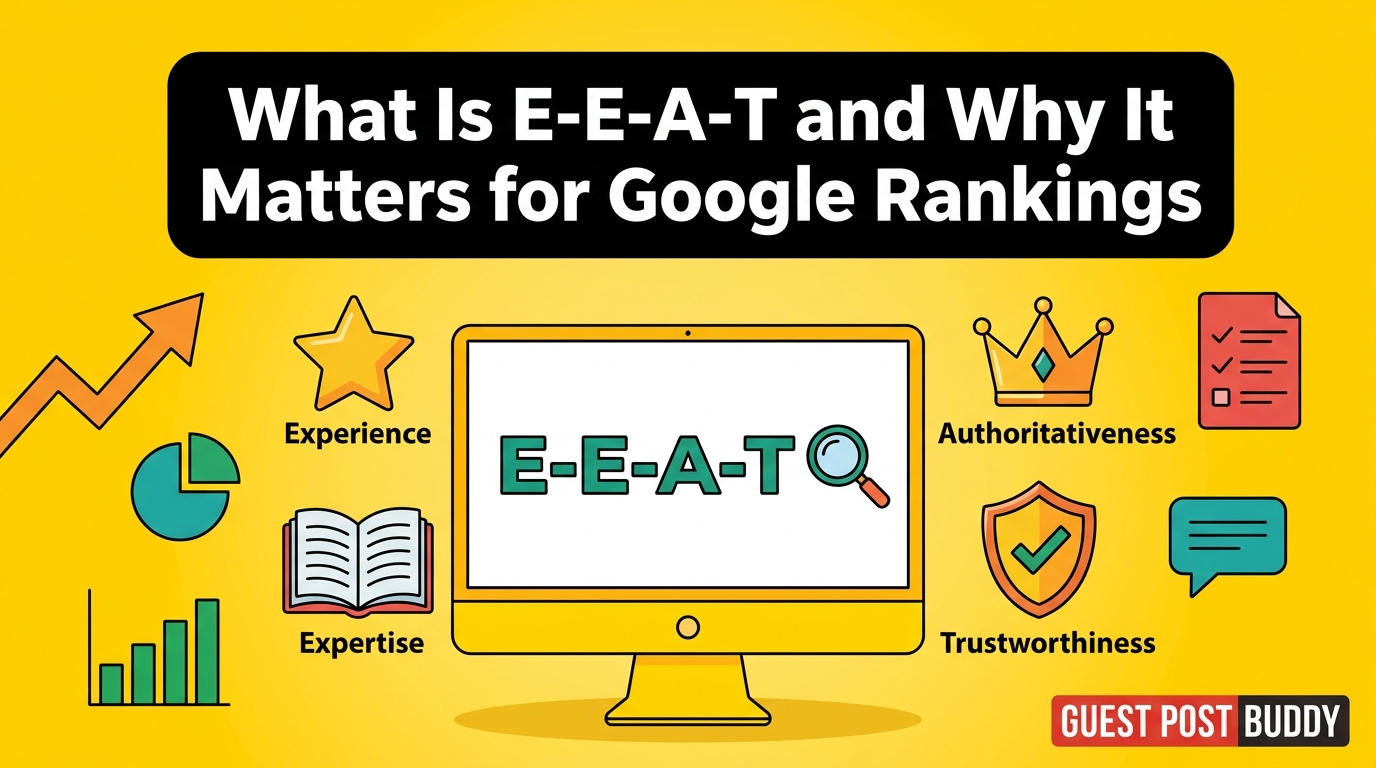
E-E-A-T stands for Experience, Expertise, Authoritativeness, and Trustworthiness.
Google uses these four qualities to evaluate whether a piece of content — and the website it lives on — is worth showing to people. Think of it like a quality checklist that Google’s systems and human reviewers run through when deciding if your page deserves a spot on the first page of results.
Here is a quick breakdown of each letter:
- E — Experience: Has the person who wrote this actually lived through what they are writing about?
- E — Expertise: Do they genuinely know what they are talking about?
- A — Authoritativeness: Are they recognised as a credible source in their field?
- T — Trustworthiness: Can readers (and Google) trust this website and its content?
The second “E” for Experience was only added in December 2022. Before that, it was simply E-A-T. The addition of Experience was a significant shift — Google was making it clear that it values real-world, lived knowledge, not just formal qualifications.
Where Does E-E-A-T Come From?
E-E-A-T comes from Google’s Search Quality Rater Guidelines — a document that Google publishes for human reviewers it employs around the world. These reviewers do not directly change rankings. Instead, they evaluate search results and give Google feedback that helps improve its algorithms over time.
The guidelines are long — over 160 pages — but E-E-A-T sits right at the heart of them. Google uses the concept to train its systems to understand quality content at a human level.
So when you hear people say “write for humans, not search engines,” E-E-A-T is a big part of why that advice holds true.
Breaking Down Each Part of E-E-A-T
Experience — Have You Actually Done This?
This is the newest addition, and honestly, it makes a lot of sense.
Imagine you are looking for advice on hiking the Scottish Highlands. Would you rather read an article written by someone who has actually walked those trails in the rain, stayed overnight in a bothy, and knows which paths flood in autumn — or someone who has simply read about it online and stitched information together?
The answer is obvious. And Google feels the same way.
Experience means first-hand knowledge. It shows up in the way content is written. A product review written by someone who actually bought and used the product feels different to one that is clearly scraped together from other reviews. A travel guide written by someone who has been there reads differently to a generic listicle.
Google looks for signals of genuine experience, including:
- Personal anecdotes and real-life stories
- Specific details that only someone who has done something would know
- Photos or proof of real-world involvement
- Reviews and accounts grounded in direct use or practice
For content creators, this is a huge opportunity. If you have lived experience — use it. Share it. It is one of the most powerful ways to stand out.
Expertise — Do You Actually Know Your Subject?
Expertise is about depth of knowledge. It is the difference between someone who dabbles in a topic and someone who has genuinely studied, practised, or built a career around it.
Now, here is something important that many people get wrong about expertise — Google does not always require formal qualifications. A certified financial planner writing about pensions has a certain kind of expertise. But a person who paid off £40,000 of debt in three years through disciplined budgeting also has expertise — just a different kind.
Google separates expertise into two broad categories:
Formal expertise — relevant for topics like medicine, law, finance, and science. If you are writing about heart surgery or tax law, Google expects credentials. This is especially important for what are called YMYL topics (more on that in a moment).
Everyday expertise — relevant for lifestyle, experience-based, and practical content. You do not need a degree to write a compelling guide on managing toddler tantrums if you are a parent of three who has genuinely figured it out.
The key signal for expertise in content is depth. Does the article actually go beyond the surface? Does it answer follow-up questions the reader has not even thought to ask yet? Does it demonstrate that the writer understands the nuances of the topic?
Shallow content written to tick boxes signals low expertise. Thorough, well-explained, practical content signals high expertise. It really is that straightforward.
Authoritativeness — Are You Recognised as a Go-To Source?
Expertise is what you know. Authority is whether other people recognise that you know it.
This is where your external reputation comes in. Google pays attention to signals that show the wider internet treats you as a credible voice in your niche. These signals include:
- Backlinks from credible websites — when reputable sites link to your content, it signals that your work is worth referencing
- Mentions and citations — being quoted, referenced, or mentioned by industry publications and experts
- Author reputation — if an author is published in respected outlets, has an established profile, or is cited in their field, that matters
- Brand recognition — if people search for your brand specifically, that tells Google your name carries weight
Authority is partly why newer websites often struggle to rank competitively for tough topics early on. It takes time to build a track record. But it also means that once you have built real authority, it becomes a lasting advantage.
Building authority is not about gaming the system. It is about doing genuinely good work, creating content people actually want to share and reference, and building relationships in your industry. That is it.
Trustworthiness — Can People Rely on You?
Trustworthiness is the backbone of all of E-E-A-T. In fact, Google’s own guidelines say that Trust is the most important of all four elements. The others feed into it.
Trust is about whether your website and content are honest, transparent, and safe. Google looks at a wide range of signals here:
- Accurate information — content that is factually correct and up to date
- Clear authorship — who wrote this? Is there an about page? Are authors named?
- Transparent business information — contact details, privacy policies, terms of service
- Website security — does your site use HTTPS?
- Honest reviews and testimonials — not cherry-picked or fabricated
- No hidden agendas — sponsored content is disclosed, affiliate relationships are clear
One of the quickest ways to damage trust is to have outdated content with wrong information, or to present opinion as fact without making it clear. Another is hiding who you are or what your business does.
Readers can feel when something is off. And increasingly, so can Google.
Why E-E-A-T Matters Even More for YMYL Content
YMYL stands for Your Money or Your Life — a term Google uses to describe content that can directly impact someone’s health, safety, finances, or wellbeing. Examples include:
- Medical advice and symptoms
- Legal guidance
- Financial planning and investment
- News and current events
- Safety information
For YMYL topics, Google applies E-E-A-T standards with far greater strictness. The reasoning is simple: if someone gets bad advice from a random blog about, say, a drug interaction or a legal process, real harm can follow. The stakes are high. So Google’s bar for quality is higher.
If your website operates in any YMYL territory, E-E-A-T is not just a ranking factor — it is your gateway to being taken seriously at all.
How Google Actually Measures E-E-A-T
Here is an important truth: E-E-A-T is not a score. There is no dashboard where you log in and see your E-E-A-T rating. It is a concept, not a metric.
What Google does is use a combination of:
- Algorithms that look for signals across your content, site structure, and link profile
- Human quality raters who evaluate results and provide feedback
- Machine learning systems trained on the feedback from those raters
Over time, Google gets better at understanding what genuine quality looks like. Sites that consistently produce high-quality, trustworthy, well-authored content see lasting benefits in rankings. Sites that cut corners, use AI to churn out low-quality content at scale, or present misleading information tend to get filtered out — especially after Google’s core updates.
What You Can Do to Improve Your E-E-A-T
Here is the practical part. And I want to be honest with you: improving E-E-A-T is not a quick fix. It is a long-term investment. But it is absolutely worth making.
1. Write From Real Experience
If you have used the product, visited the place, tried the method — say so. Add personal detail. Describe what surprised you, what went wrong, what worked better than expected. This kind of content is genuinely hard to fake, and readers recognise it immediately.
2. Be Transparent About Who You Are
Create a proper About page. Add author bios to your articles. Include credentials, experience, or relevant background. If you are a business, display your contact information clearly. Let people know there is a real human being — or team — behind the website.
3. Keep Your Content Accurate and Updated
Outdated content is a trust killer. If you wrote a guide in 2021 and nothing has been touched since, readers — and Google — can tell. Schedule regular content audits. Update statistics, check facts, and add new information where relevant.
4. Build Backlinks the Right Way
Seek mentions and links from sites that are genuinely relevant and respected in your niche. Guest posting, digital PR, expert contributions, and being quoted in industry articles all help build legitimate authority. Avoid spammy link schemes — they tend to backfire badly.
5. Create In-Depth, Useful Content
Stop writing thin, 500-word articles that skim the surface of a topic just to have something published. Go deep. Answer the full question. Anticipate follow-up questions and address them. Length is not the goal — usefulness is. But truly useful content on complex topics tends to be thorough.
6. Build Your Author’s Online Presence
If you are the writer, build a presence beyond the site. Publish in other respected outlets. Be active in communities related to your niche. Get your name associated with quality content across the web. This is how authority grows.
7. Secure Your Website and Be Legally Transparent
Make sure your site uses HTTPS. Have a proper privacy policy. If you earn through affiliate links or sponsored posts, disclose it clearly. These signals all feed into trust.
The Big Picture: E-E-A-T Is Google’s Way of Rewarding Real Quality
There is a reason Google keeps updating its algorithm and why E-E-A-T has become such a central framework. The internet is flooded with content. Millions of articles are published every single day. A huge portion of it is low quality, misleading, or simply copied and reworded.
Google’s entire business depends on showing people the best possible results. If someone searches for advice on managing their blood pressure and Google sends them to a website full of inaccurate, outdated information, that person is going to lose trust in Google — and look elsewhere.
E-E-A-T is Google’s answer to this problem. It is a framework for filtering out the noise and surfacing content that is genuinely worth reading.
For anyone creating content online, this is actually good news. If you are putting in the work — writing from real knowledge, being transparent, building a legitimate reputation — E-E-A-T rewards that. It levels the playing field against those who are trying to game the system with shortcuts.
Final Thought
E-E-A-T is not a technical trick you apply once and forget. It is a philosophy of content creation. It asks a simple question of every piece of content you put out: Is this genuinely helpful? Is it honest? Does the person who wrote it actually know what they are talking about?
If the answer is yes, you are already on the right track.
The websites that will win in search — now and in the future — are the ones that treat their readers with respect, write with real knowledge, and build trust over time. That has always been the goal of good writing. Google is simply getting better at recognising it.