

Introduction: Why Most People Choose the Wrong Keywords
Let me tell you something that most SEO guides won’t admit upfront.
The biggest reason websites fail to rank on Google isn’t bad writing. It isn’t poor website design. It isn’t even a lack of backlinks.
It’s choosing the wrong keywords.
I’ve seen it dozens of times — a brand-new website owner pours weeks of effort into a beautifully written blog post targeting “weight loss tips” or “best laptops,” then wonders why they’re sitting on page 47 of Google with zero visitors six months later.
The problem wasn’t their content. The problem was they picked a fight they couldn’t win — at least not yet.
That’s exactly what keyword difficulty is designed to help you avoid.
In this guide, I’m going to break down keyword difficulty in a way that actually makes sense. No confusing jargon, no vague advice. By the time you finish reading this, you’ll know precisely which keywords are worth your time and which ones you should leave alone until you’re ready.
Let’s get into it.
What Is Keyword Difficulty?
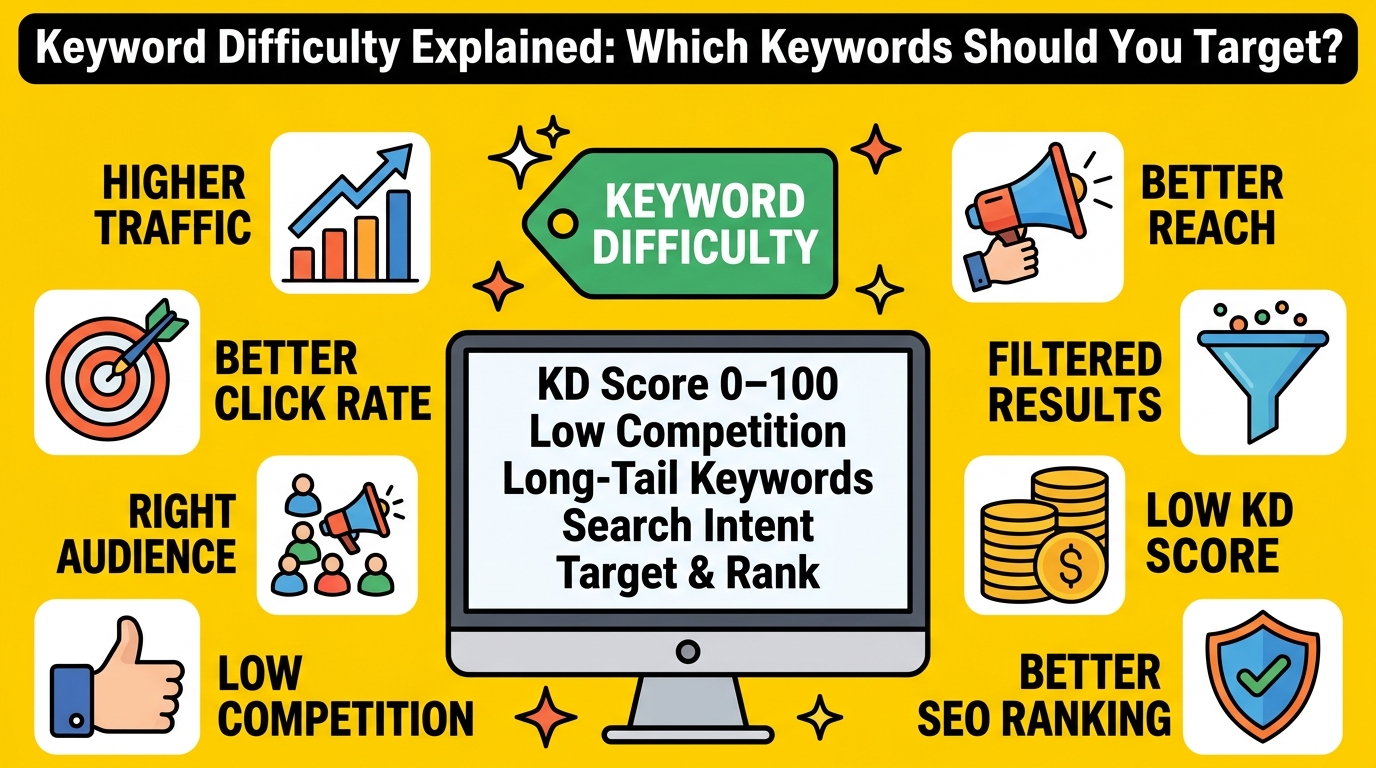
Keyword difficulty (often shortened to KD) is a metric used by SEO tools to estimate how hard it would be to rank on the first page of Google for a particular search term.
Think of it like a difficulty rating on a video game. Some levels are easy — you can walk right through them. Others are incredibly challenging and require a lot more experience and resources before you have any chance of winning.
Keyword difficulty works the same way.
If you search for something like “what is a PDF,” that’s a relatively easy keyword. The competition is lower, and a well-written, helpful article has a genuine shot at ranking.
But if you search for “car insurance,” you’re up against enormous companies with millions in marketing budgets, thousands of backlinks, and years of SEO history. Trying to rank for that as a new website is like showing up to a Formula 1 race in a Fiat Punto.
Keyword difficulty scores are usually displayed as a number between 0 and 100:
- 0–20 — Very easy. Great for new or small websites.
- 21–40 — Easy to moderate. Achievable with decent content and some links.
- 41–60 — Moderate. You’ll need solid domain authority and good on-page SEO.
- 61–80 — Hard. Requires significant backlink profiles and established sites.
- 81–100 — Very hard to nearly impossible for most sites. Big brands dominate here.
Different SEO tools — Ahrefs, Semrush, Moz, Ubersuggest — each calculate this score slightly differently. But the general principle is the same: the higher the score, the tougher the competition.
How Is Keyword Difficulty Calculated?
Here’s where it gets interesting.
Keyword difficulty isn’t just pulled out of thin air. SEO tools analyse the pages that are currently ranking in the top 10 results on Google for that keyword. They look at several factors to determine how strong the competition is:
1. Backlink Profiles
The number and quality of backlinks pointing to the ranking pages is one of the most important signals. If every page on page one has hundreds or thousands of links from authoritative websites, it tells the tool that this keyword is fiercely competitive.
2. Domain Authority
Are the pages ranking from massive sites like Forbes, WebMD, or Amazon? Or are smaller independent blogs holding those spots? When established, high-authority domains dominate the results, the keyword difficulty score rises.
3. Content Quality and Relevance
Some tools factor in how well-optimised the existing top pages are. If competitors have long, thorough, expertly structured content, that raises the bar you need to clear.
4. Search Volume
High-traffic keywords attract more competition naturally. When thousands of people search for something every month, you can bet that companies and bloggers have already noticed and fought hard for those rankings.
5. SERP Features
Google sometimes fills the first page with featured snippets, video carousels, or shopping ads. These elements push organic results down and make it even harder to get meaningful clicks, even if you do rank.
It’s worth noting that no keyword difficulty tool is perfectly accurate. They’re estimates. But they’re useful estimates that give you a solid strategic starting point.
Why Keyword Difficulty Matters (More Than Most People Realise)
Imagine spending three months writing a 5,000-word article on a topic, putting it live, then watching it sit untouched at the bottom of search results.
That is demoralising. And it’s completely avoidable.
Keyword difficulty helps you work smarter, not harder. It allows you to:
- Focus your energy on winnable battles — especially when your website is new
- Build momentum early with rankings that grow your authority over time
- Allocate your content budget effectively if you’re running a business
- Spot opportunities that your competitors have missed
- Plan a long-term strategy that scales as your authority grows
Here’s the truth: ranking for even a modest keyword that gets 200 searches a month can bring a steady stream of genuinely interested visitors to your site. That’s far more valuable than almost ranking for something that gets 50,000 searches but where you’re buried on page 5.
Traffic only helps you if people can actually find you.
The Keyword Difficulty Sweet Spot: What You Should Actually Be Looking For
Now we get to the part most guides skim over: not just understanding keyword difficulty, but knowing what to do with it.
The sweet spot for most websites — especially newer ones — lies in keywords with:
- A KD score between 0 and 30
- Decent monthly search volume (anywhere from 100 to 2,000+ depending on your niche)
- Clear user intent that matches what you’re offering
- Long-tail variations of a broader topic
This is the goldmine most beginners walk right past because these keywords feel “too small.” But small doesn’t mean worthless. Quite the opposite.
Long-Tail Keywords: Your Best Friend in the Early Days
If keyword difficulty is the game, long-tail keywords are the cheat code.
A long-tail keyword is a longer, more specific phrase — usually three to five words or more. These phrases have lower search volumes, but they also tend to have significantly lower keyword difficulty scores. More importantly, they attract users who know exactly what they want.
Let’s look at an example.
The keyword “coffee” has millions of monthly searches but an impossibly high difficulty score. You will never rank for it without years of serious authority building.
But “best coffee beans for a French press under £20”? That’s a completely different story. Fewer people search for it each month, yes — but the people who do are ready to buy. The competition is lighter. And a well-written article targeting that exact phrase has a real shot at ranking within weeks, not years.
This is the power of long-tail keywords: lower difficulty, higher intent, faster results.
As your website grows, you naturally start winning those smaller keywords, building authority along the way — which eventually opens the door to more competitive terms. It’s a staircase, not a leap.
Search Intent: The Missing Piece That Keyword Difficulty Alone Won’t Tell You
Here’s something critically important that many people miss.
Keyword difficulty only tells you how hard it is to rank. It doesn’t tell you whether you’re targeting the right people.
That’s where search intent comes in.
Search intent is the reason behind a search. Why is someone typing those words into Google? Understanding intent is what separates content that ranks from content that ranks and converts.
There are four main types of search intent:
Informational Intent
The user wants to learn something. Example: “how does keyword difficulty work” → Write a detailed educational article. That’s what you’re reading right now.
Navigational Intent
The user wants to find a specific website or page. Example: “Ahrefs keyword explorer login” → These searches are usually brand-specific. Not great targets for content unless it’s your own product.
Commercial Intent
The user is researching before making a purchase. Example: “best keyword research tools for small businesses” → Write comparison articles, reviews, or round-ups that help them choose.
Transactional Intent
The user is ready to buy or take action right now. Example: “buy Ahrefs subscription” → These are perfect for product pages and landing pages, not blog posts.
When you pick a keyword, you need to match your content to the intent behind it. Even a low-difficulty keyword won’t help you if your content answers a completely different question than what the user is asking.
How to Find Low-Difficulty Keywords That Are Actually Worth Targeting
Let me walk you through the practical process I use — and one that any writer or website owner can follow, regardless of budget.
Step 1: Start With a Seed Topic
Think about the broad subject your website covers. Don’t worry about keywords yet — just the topic. For example: “home vegetable gardening.”
Step 2: Open a Keyword Research Tool
Free options include Google Keyword Planner, Ubersuggest (limited free searches), and Google Search Console if your site already has traffic. Paid tools like Ahrefs and Semrush give much deeper data.
Type in your seed topic and see what comes up.
Step 3: Filter by Keyword Difficulty
Most tools let you filter results by KD score. Set the maximum to somewhere between 20 and 35 to start. You’ll immediately see a more manageable list of realistic targets.
Step 4: Look at Monthly Search Volume
You want keywords that people are actually searching for. A KD of 5 is great, but if only two people search for it per month globally, it’s not worth your time. Aim for at least 100–500 searches per month as a starting floor.
Step 5: Check the SERP Yourself
Here’s a step most people skip, and it’s one of the most important. Before you commit to a keyword, search for it on Google yourself. Look at the first page.
- Are the results from massive, household-name websites?
- Are they from smaller blogs or independent sites?
- Is the content outdated? Could you genuinely do better?
- Does Google show ten blue links, or is it cluttered with ads and SERP features?
Your eyes can often tell you more than any tool can. If the first page is full of Reddit threads and small blogs on a topic you know well, that’s a green light.
Step 6: Group Keywords by Intent and Topic
Once you’ve identified ten to twenty promising keywords, group them into clusters. A cluster is a group of related keywords you can address in a single piece of content or a series of articles. This not only saves time but also tells Google that your site has genuine depth on a topic.
Common Keyword Targeting Mistakes to Avoid
Experience has taught me that even smart, hardworking people fall into the same traps when choosing keywords. Here are the ones to watch out for.
Chasing Volume Over Opportunity
High search volume is attractive. But volume without realistic ranking potential is meaningless. A keyword with 100 monthly searches and a KD of 8 will serve you far better than one with 10,000 monthly searches and a KD of 85.
Ignoring the Competition’s Quality, Not Just Their Authority
Sometimes a high-difficulty keyword can still be cracked if the existing content is genuinely poor. If every article on page one is thin, outdated, or fails to answer what users actually need, a truly excellent piece of content can muscle in. Difficulty scores don’t measure content quality — you have to assess that yourself.
Targeting the Same Keywords as Every Other Site in Your Niche
It’s tempting to see what your competitors are ranking for and copy their strategy. But that approach just puts you in a head-to-head battle on their turf. Instead, look for the keywords they’ve missed — the gaps in their content coverage.
Ignoring Your Own Site’s Current Authority
If you’re brand new, even a keyword with a KD of 30 might be a stretch. Be honest about where you are right now, and build up systematically.
Forgetting That Rankings Take Time
Even perfect keyword targeting requires patience. For a new website targeting low-difficulty keywords, you might start seeing movement in four to twelve weeks. For more competitive terms, it could be six to eighteen months. Build consistently, and the results will come.
Building a Keyword Strategy That Grows With You
Let’s zoom out and talk about the bigger picture.
A healthy keyword strategy isn’t a one-time exercise. It’s an ongoing process that evolves as your website grows. Here’s a simple framework to think about it in three phases:
Phase 1: Foundation (New Website, Low Authority)
Focus almost entirely on low-difficulty, long-tail keywords. Write content that genuinely helps people. Answer specific questions thoroughly. Build a reputation in your niche. At this stage, winning small is a big deal.
Phase 2: Growth (Some Authority, Growing Backlinks)
Start gradually testing medium-difficulty keywords — KD 30–50. By now you’ve built some credibility with Google. You understand your audience better. Your content is getting shares and links. Expand your topic clusters and go deeper on your strongest performing content.
Phase 3: Authority (Established Domain, Strong Backlink Profile)
You can now realistically target higher-difficulty terms. But even at this stage, the smartest SEOs still mix in low and medium-difficulty keywords because they deliver consistent traffic with less effort. The goal is always the best return on your time and resources.
Useful Tools for Assessing Keyword Difficulty
You don’t need to spend a fortune on tools to do keyword research well. Here’s a quick rundown of what’s available:
- Ahrefs — Industry gold standard. Excellent keyword difficulty scores and SERP analysis. Paid plans start around $99/month.
- Semrush — Hugely popular, particularly for competitive analysis and tracking. Similar pricing to Ahrefs.
- Moz Keyword Explorer — A more affordable option with solid difficulty metrics and useful beginner-friendly features.
- Ubersuggest — Neil Patel’s tool offers free searches and is a good entry point. Less detailed than Ahrefs or Semrush.
- Google Keyword Planner — Free with a Google Ads account. Good for volume data, though it doesn’t give a difficulty score.
- Google Search Console — Invaluable if your site already has traffic. Shows you which queries you’re already ranking for, so you can double down on what’s working.
- AnswerThePublic — Great for finding question-based keywords that reveal exactly what people want to know.
A Final Word: Think Like Your Reader, Not Like an Algorithm
After everything we’ve covered — scores, tools, intent, competition — I want to bring it back to something simple.
The best keyword strategy in the world won’t save content that nobody wants to read.
Your job, first and always, is to genuinely help the person on the other side of the screen. When you understand what they’re searching for, why they’re searching for it, and what would truly solve their problem, the keyword strategy almost writes itself.
Low-difficulty keywords are a door. Great content is what convinces people to walk through it and stay.
Start small, aim to be the most helpful resource on your chosen topic, build consistently — and watch the traffic follow.
Summary: Key Takeaways
- Keyword difficulty is a score (0–100) that tells you how hard it is to rank for a keyword on Google’s first page.
- It’s calculated by analysing the backlinks, authority, and content quality of pages currently ranking.
- New and small websites should focus on keywords with a KD score of 0–30.
- Long-tail keywords offer lower competition, higher intent, and faster results.
- Always match your content to the search intent behind the keyword.
- Use tools like Ahrefs, Semrush, or even free options like Google Search Console to find opportunities.
- Manually check the SERP yourself — tool scores are guides, not gospel.
- Build your keyword strategy in phases as your website authority grows.
- Consistency, patience, and genuine helpfulness will always win in the long run.